Yellowstone National Park: How to Visit This Iconic U.S. Park
Yellowstone National Park spans nearly 9,000 km² (with 96% in Wyoming, 3% in Montana, and 1% in Idaho). As large as Corsica
Yellowstone National Park spans nearly 9,000 km² (with 96% in Wyoming, 3% in Montana, and 1% in Idaho). As large as Corsica, this vast territory—listed by UNESCO for its geothermal phenomena and abundant wildlife—naturally evokes adventure... However, due to its tourism success and immensity, visiting this iconic park in the Northwest United States requires careful planning! Follow us and discover how to visit Yellowstone safely and without difficulty.
Visiting Yellowstone: The 3 Questions to Ask Before Your Trip
1. Which entrance should you choose?
The park's 5 entrances
Yellowstone National Park is accessible via five entrances.
North (North Entrance) via Gardiner (US-89), open year-round. According to the park's official information, it is open to all vehicles in winter "from the north entrance at Gardiner, Montana, through the park to Cooke City, Montana (via Tower Junction)."
Northeast (Northeast Entrance) via the Beartooth Highway (US-212), accessible from late May to late October.
East (East Entrance) from Cody (US-20), accessible from early May to late October.
South (South Entrance) from Jackson and Grand Teton National Park (US-89), open from mid-May to late October.
Iconic sites by entrance
Choosing the right entrance is not random. It depends on your trip logistics (the airport where you land and your overall road trip), but also on the zones you wish to discover as a priority in the park.
Entrance | Iconic Sites |
West (West Yellowstone, Montana) | Geysers, Old Faithful, Lower Geyser Basin, Norris Geyser Basin, Madison River |
South (via Grand Teton) | Grand Teton, Yellowstone Lake, West Thumb, Continental Divide, Lewis Falls |
East (Cody, Wyoming) | Yellowstone Lake, Hayden Valley, Mud Volcano, Fishing Bridge |
North (Gardiner, Montana) | Mammoth Hot Springs, Roosevelt Arch, Fort Yellowstone, quick access to Norris |
Northeast (Cooke City, Montana) | Lamar Valley (nicknamed the American Serengeti!), Tower Fall, scenic Beartooth Highway |
Finally, to choose the right Yellowstone entrance, remember that:
Only the north entrance is open in winter.
When open, roads are accessible 24/7.
All visitor centers are open in summer. In winter, only Albright Visitor Center (located at Mammoth Hot Springs) and West Yellowstone Visitor Information Center (located just outside the park's west entrance) are open.
2. Where should you land to visit Yellowstone?
Choosing the right entrance depends not only on the attractions you wish to visit, but also on the closest airport to the park—if your road trip begins when you exit the plane.
Salt Lake City Airport (SLC): it is located about 5 hours from the park's west entrance (or about 7.5 hours to the south entrance, if you pass through Grand Teton National Park). Two routes allow you to reach Yellowstone from SLC:
via I-15 north to Idaho Falls, then Route 20 to the west entrance
via I-15 north to Brigham City, then Routes 89 and 191 to Grant Village, near the south entrance
Jackson Hole Airport (JAC): it is located about 1.5 hours from Yellowstone's south entrance. From JAC, take US-191 North.
Bozeman Airport (BZN): it is 1.5 hours by car from the park's north entrance, via Gardiner
Billings Airport (BIL): it is 2 hours 45 minutes by car from the north entrance (via the town of Gardiner, in Park County) or from the East entrance (via the town of Cody).
West Yellowstone Airport (WYS): this small airport (located at the park's west entrance) does not serve international flights. If you arrive from abroad, you will not be able to land there directly; you will need to connect through another airport, such as SLC.
To Remember ● WYS is the closest airport to the park (less than 10 km from the west entrance) but it only serves domestic flights (mainly in the summer season). ● SLC and BZN airports are located about 1.5 hours from the park and offer a wider range of domestic and international flights. ● BIL airport is 2 hours 45 minutes from the park, accessible mainly via the north and east entrances. It is the best option in winter, when only the north entrance is open. |
What is the best time for a Yellowstone road trip?
Yellowstone is beautiful in every season. The "best" time to visit depends mainly on the activities you wish to do there—and the weather conditions you prefer.
Spring (March to June)
As winter fades, the park slowly emerges from hibernation. While all roads gradually reopen (starting early April), temperatures begin to rise, with mercury hovering around 12°C in May.
At this time, mountainous areas remain quite cold at altitude. It is still possible to snowshoe through the snow... This is a low-tourism season, ideal for observing black bears and elk.
Summer (June to September)
This period offers pleasant daytime temperatures—somewhat varying by zone within the park, between 17°C and 24°C (not much higher). Very touristy (especially July-August, after several months of limited access), the park welcomes 80% of its annual visitors! Parking lots become congested and lead to long wait times…
On the flip side, summer allows you to observe numerous animals (particularly herds of bison), to enjoy boat, kayak, or canoe outings on Yellowstone Lake. It is also a season ideal for beautiful hikes—there are some off-the-beaten-path trails if you venture away from major attractions...
To enjoy the park away from crowds, choose early June or September instead, when tourist numbers diminish.
Autumn (September to December)
With temperatures varying between 10°C and 16°C, this season marks the end of the summer period and, with it, the closure of some tourist activities, such as boat outings. Nevertheless, it is a perfect time to observe numerous animals (including coyotes, bears, and elk). It is also the time of year when Yellowstone proudly displays beautiful reddish hues… and receives its first snows (late October).
Winter (December to March)
At this time, Yellowstone becomes somewhat harsh, with temperatures well below freezing (down to -20°C at altitude). Snow covers much of the park, and most roads are closed, except for the north entrance. In this season, you can enjoy sledding or snowmobile excursions. Wolves are also easy to spot...
What are the keys to a successful Yellowstone visit?
Setting your budget: Is Yellowstone an expensive trip?
The cost of a Yellowstone trip depends on the length of your stay and the type of accommodation (more or less luxurious). Add to this meal expenses, which depend on your eating habits: quick bites, picnics, restaurants, etc. Here is an overview of costs and rates* to help you set your budget (excluding airfare).
1/ Entrance fees
The entrance price to Yellowstone varies based on your mode of transport. The rates below apply per vehicle (not per person), meaning a single entrance fee is required for all passengers. The entrance ticket is valid for seven consecutive days.
for a vehicle (car, van): $35
for a motorcycle: $30
for a pedestrian or cyclist (from age 16): $20
To save time upon arrival (especially in summer), feel free to purchase your pass online, on the official website! Otherwise, they can be purchased at each park entrance (except in winter).
An official Yellowstone park map is provided free at the entrance, but a GPS can be useful. Note that some areas lack cellular coverage, so it is advisable to download your map beforehand for offline consultation.
2/ Accommodation
Inside the park
Campgrounds: Yellowstone has about a dozen campgrounds. While some can be reserved in advance (Mammoth, Canyon, Bridge Bay, Madison, Grant Village, Fishing Bridge RV Park), others require arriving very early in the morning to secure a spot—a risky gamble during peak season.
Prices range from $25 to $90 per night. Rates depend on the campground's prestige, but also your location: when booking, you will need to specify your tent size and/or RV length (if you own a recreational vehicle, camper, or van).
Lodges: depending on their comfort level and geographic location, prices can vary. For example, Old Faithful Inn (located right next to the famous geyser) displays rates between $205 and $1,452, depending on room type and basin views! Generally, well-reviewed establishments hover around $250-$300 per night for two people.
Reservations for lodges, campgrounds, and certain activities (such as horseback riding or snowmobile sessions) within Yellowstone open up to 13 months in advance, on the 5th of each month.
Note For environmental reasons, there is no television, air conditioning, or Internet access in campgrounds and facilities; except for some prestigious hotels offering paid Internet access. Always in respect for the environment, all accommodations are also non-smoking. |
Outside the park
During peak summer season (mid-June to late September), faced with high demand, prices rise and reach levels comparable to lodgings within Yellowstone. Outside peak summer, rates are somewhat lower.
To stay near the park, consider looking around the towns of West Yellowstone, Gardiner, Cody, and Jackson Hole. As with accommodations inside the park, booking is highly recommended.
Where to eat at Yellowstone? ● The park has several snack bars, cafeterias, and restaurants—including some upscale establishments accessible only by reservation. Each "village" also has one or more supply points. ● If you are camping, never leave food unattended, as a precaution. Why? Food odors attract wildlife, bears in particular! ● If you plan expeditions to more remote areas of the park, bring enough water and food for the excursion. |
(*) All prices listed are for April 2025 and subject to change
Planning your movements
Choosing your vehicle
Paved (or closed in winter), the main roads in Yellowstone are drivable and do not require renting a 4x4. It is perfectly possible to opt for the comfort of a sedan, or an SUV if you are planning an excursion to a slightly more "rugged" area. If you wish to camp within the park, you can also opt for a van.
In winter, access to certain activities offered in Yellowstone (such as snowshoeing or snowmobile excursions) is only available via snowcoaches. These special shuttles handle transfers to winter attractions—from accommodations and specific points.
Filling up on gas
If possible, fill up before entering the park, as fuel prices there are higher than outside (between $0.50 and $1 extra per liter). The park's gas stations are called YPSS (Yellowstone Park Service Stations). You will find them at:
Old Faithful
Grant Village
Fishing Bridge service station
Fishing Bridge
Tower/Roosevelt Junction
Mammoth Hot Springs
Deciding whether to take the bus
The park also offers an internal transportation service called Yellowstone National Park Transportation. These seasonal buses (typically May to October) follow the park's most popular routes to showcase iconic sites. Note that guided bus tours are also offered by private companies.
Choosing your itinerary
Since Yellowstone is an immense park, it is essential to plan your movements in advance (improvising on-site could cost you valuable time). There are many circuits. Among the main ones:
Upper Loop Road (north loop),
Lower Loop Road (south loop),
Grand Loop Road (complete main loop),
North Rim Drive (Yellowstone Grand Canyon),
Lamar Valley Drive (wildlife).
Respecting safety rules and (eco)responsible practices
Both for your safety and to preserve Yellowstone's natural riches, you should:
Follow safety guidelines at tourist sites
The park is an active volcanic territory. Certain areas, such as Grand Prismatic Spring or Norris Geyser Basin, can reach extreme temperatures! As a safety measure (and for survival), it is important to be cautious (not ignoring warning signs, staying on marked trails, not approaching geysers too closely, etc.)
Keep your distance from local wildlife
Some visitors tend to forget this: Yellowstone is not a zoo! Animals roam freely there, in their natural habitat, and approaching them too closely can make them aggressive… It is recommended to maintain a distance of 25 meters between you and wildlife and at least 100 meters for large predators, such as bears or wolves.
Note that park administration permits the use of "bear spray" made from pepper, in case of danger. These sprays are sold at the park's gas stations or in shops of surrounding towns ($50).
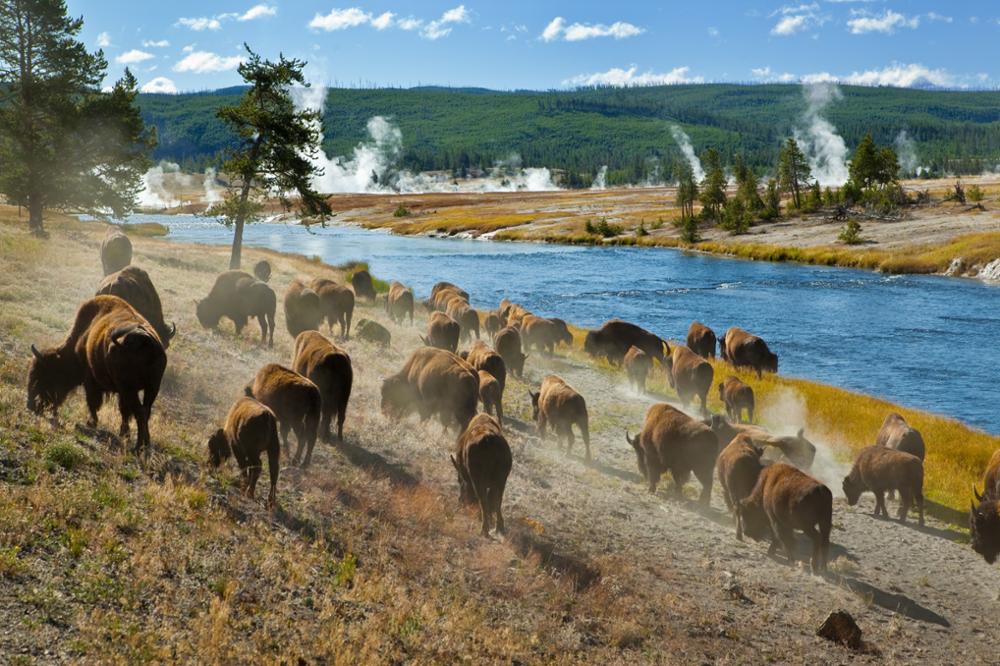
What wildlife can you see at Yellowstone? Yellowstone is an important wildlife refuge. Among its numerous species, you can observe: ● Grizzly bears: approximately 150 specimens are counted in the park. They can be observed in spring and summer at Hayden Valley and Lamar Valley, near the park's East entrance. ● Black bears: nearly 600 bears live at Yellowstone. They are frequently spotted around Mammoth and Tower-Roosevelt in spring and autumn, when searching for food. ● Bison: with over 4,800 specimens, bison are easy to observe at Lamar Valley, particularly from late July to late August, during the breeding period. ● Wolves and coyotes: wolves (about a hundred) live mainly in the park's northeast, especially in Lamar Valley, where they can be seen in autumn and winter. You may also spot coyotes—whose size is somewhat similar to wolves, but smaller. ● Elk: between 15,000 and 25,000 specimens live within the park! They are most visible in the north and in autumn, during the breeding period. To fully enjoy this natural spectacle, do not forget to bring binoculars and a camera equipped with a good zoom lens to capture wildlife safely. |
Visiting the park responsibly
This may seem obvious, but leave no trash behind and embrace the Leave No Trace concept during your park visit—and your travels in general! This principle was created in the États-Unis in the 1980s by several government agencies—including the US Forest Service.
This concept (in 7 principles) aims to minimize tourism's impact on the environment through (eco)responsible practices and simple gestures:
do not touch historic sites,
do not pick plants,
do not bring indigenous species back in your suitcase,
do not feed wildlife (they do not need us for that!),
observe wildlife without disturbing it,
Furthermore, Yellowstone encourages the use of alternative fuels (less polluting) and environment-friendly accommodations—LEED-certified. This Leadership in Energy and Environmental Design label is a green building rating system. Several park establishments have this distinction.
What are the must-see sites in Yellowstone?
If you are still unsure which entrance to choose or which areas to visit, here is a non-exhaustive list of Yellowstone's must-sees you absolutely should see:
Mammoth Hot Springs Terraces: with its limestone formations (formed by natural hot water), this geothermal site is split into two stunning terrace zones, sometimes creamy or golden in color.
Yellowstone Grand Canyon: at 300 m deep and 300 m long, this cavity is one of the park's most striking sites. You can also admire 3 beautiful waterfalls there…
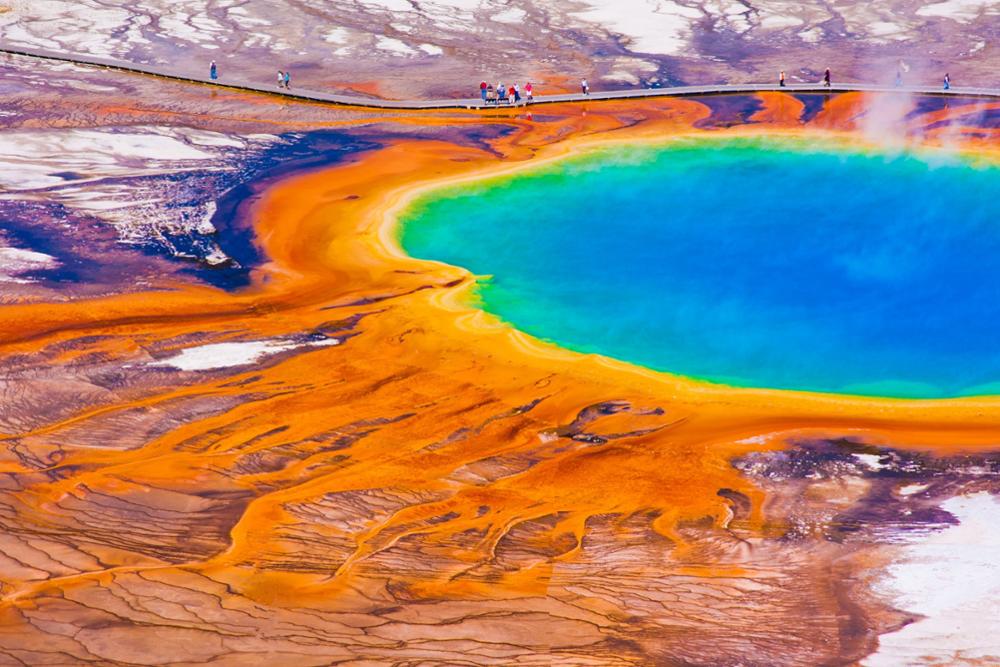
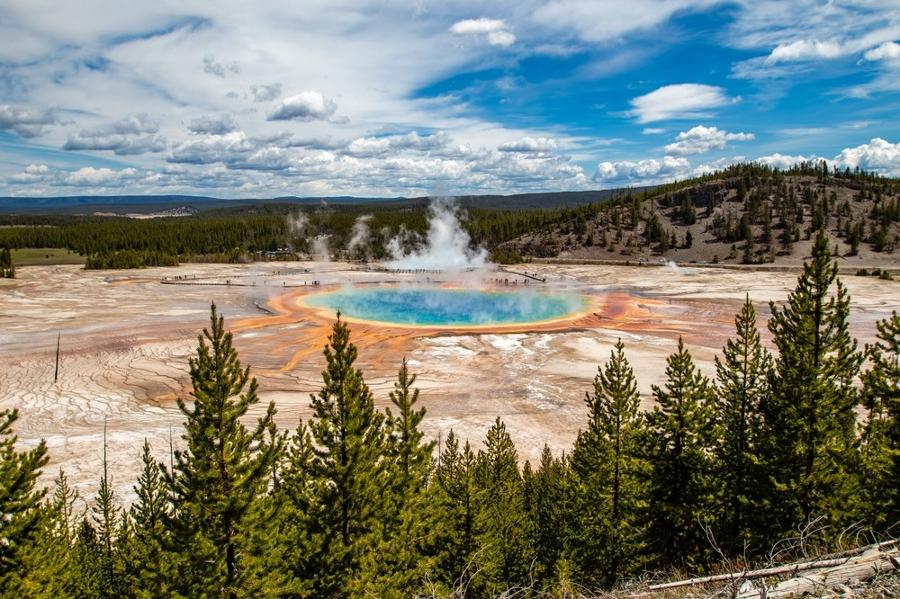
Grand Prismatic Spring: while it is the largest hot spring in the États-Unis, this one is especially renowned for its colors (orange, green, and blue)—almost fluorescent!
Norris Geyser Basin: born from volcanic activity, this geothermal zone is the park's hottest. It is divided into two basins: Porcelain Basin and Back Basin—renowned for their geysers!
Old Faithful Geyser: prized for its regular eruptions, this geyser offers a superb natural spectacle… every 90 minutes—with each new eruption!
Hayden Valley: this part of Yellowstone is a fantastic observation post for admiring wildlife. You can see grizzly bears, coyotes, and many bird species.
Yellowstone Lake: known as the largest lake in North America, this vast body of water and its surroundings offer many activities, including kayaking outings or hiking trails.
How long does it take to visit Yellowstone?
To enjoy Yellowstone without rushing, a minimum of one week is recommended. However, if you cannot stay for seven days due to time or budget constraints, plan for at least 4 days. Less than that, you will only be able to visit a very limited area—and given the travel time involved, it is not worthwhile...
Here is a suggested 4-day itinerary, with distances to cover. Travel time between different spots varies depending on your vehicle type. A bus or van itinerary will inevitably take longer than an SUV trip.
Length of stay | Sites to visit | Distance/day | Distance from one day to the next |
Day 1 | The Upper Geyser Basin area, including Grand Prismatic Spring and Old Faithful | 70 km | - |
Day 2 | Yellowstone Grand Canyon, as well as the Brink of Lower Falls and Upper Falls View waterfalls | 80-85 km | 72 km (West Entrance → South Entrance) |
Day 3 | Hayden Valley wildlife and Yellowstone Lake | 90 km | 45 km (South Entrance → Hayden Valley) |
Day 4 | Norris Geyser Basin and Mammoth Hot Springs | 105 km | 97 km (Hayden Valley → Mammoth Hot Springs) |
Frequently Asked Questions
Where is Yellowstone National Park located?
Yellowstone National Park is located in the western Estados Unidos, spanning three states: Wyoming, Montana, and Idaho. Situated on the Yellowstone volcanic plateau, this immense wilderness has five entrances.
What circuit should you take to visit Yellowstone?
Yellowstone has many circuits. One of the most renowned is the Grand Loop Road (the great 8-shaped loop), accessible from West Yellowstone (west entrance) or Gardiner (north entrance). Among other circuits—and their must-see spots: Upper Loop (Mammoth Hot Springs and Lamar Valley sites) and Lower Loop (Old Faithful, Grand Prismatic Spring, and Yellowstone Lake).
Is it possible to visit Yellowstone in 4 days?
Yes, it is possible to visit Yellowstone in 4 days (though this is the recommended minimum). The park is vast and full of iconic attractions that would be a shame to miss due to time constraints. Furthermore, the park's remote geographic location requires several hours of driving from major cities to its entrances.
Frequently asked questions
To enjoy Yellowstone without rushing, it is recommended to plan a minimum of 3 to 5 days. A full week allows you to cover both main loops (Upper Loop Road and Lower Loop Road), observe wildlife at Lamar Valley and Hayden Valley, and not miss major geothermal sites like Old Faithful and Grand Prismatic Spring.
The best time depends on your priorities. Summer (June to September) provides access to all entrances and activities, but attracts 80% of annual visitors. Early June and September are ideal for enjoying the park with fewer crowds. Spring (March-June) is perfect for observing black bears and elk in a still-quiet setting. Winter (December-March) is magical for snowmobiling and wolf watching, though only the north entrance remains open.
In 2025, the entrance fee is $35 per vehicle (car, van), $30 for a motorcycle, and $20 for a pedestrian or cyclist over 16. This ticket is valid for 7 consecutive days. It is advisable to purchase it online in advance, especially in summer, to avoid lines at entrances.
Yes, the park is home to approximately 150 grizzly bears and nearly 600 black bears. Grizzlies are most visible in spring and summer at Hayden Valley and Lamar Valley. Black bears are more frequently spotted around Mammoth and Tower-Roosevelt in spring and autumn. Always maintain at least 100 meters distance from these large predators and carry bear spray (available for $50 at park gas stations).
Yes, booking is highly recommended, especially for summer. Yellowstone's lodges and campgrounds open reservations up to 13 months in advance, on the 5th of each month. Campgrounds like Mammoth, Canyon, Bridge Bay, Madison, and Grant Village can be booked online. Without a reservation, arriving very early in the morning remains the only option for non-reservable sites, which is very risky during peak season.
Several airports allow you to reach Yellowstone. Bozeman Airport (BZN) is the most convenient, just 1.5 hours from the north entrance. Jackson Hole Airport (JAC) is 1.5 hours from the south entrance, ideal if combining your visit with Grand Teton. Salt Lake City Airport (SLC) is about 5 hours from the west entrance but offers more international connections. In winter, Billings Airport (BIL) is a good option since only the north entrance remains open.