Painted Desert
Painted Desert
North of Petrified Forest National Park in Arizona, Painted Desert stretches across colorful badlands, petroglyphs, and Route 66 heritage.
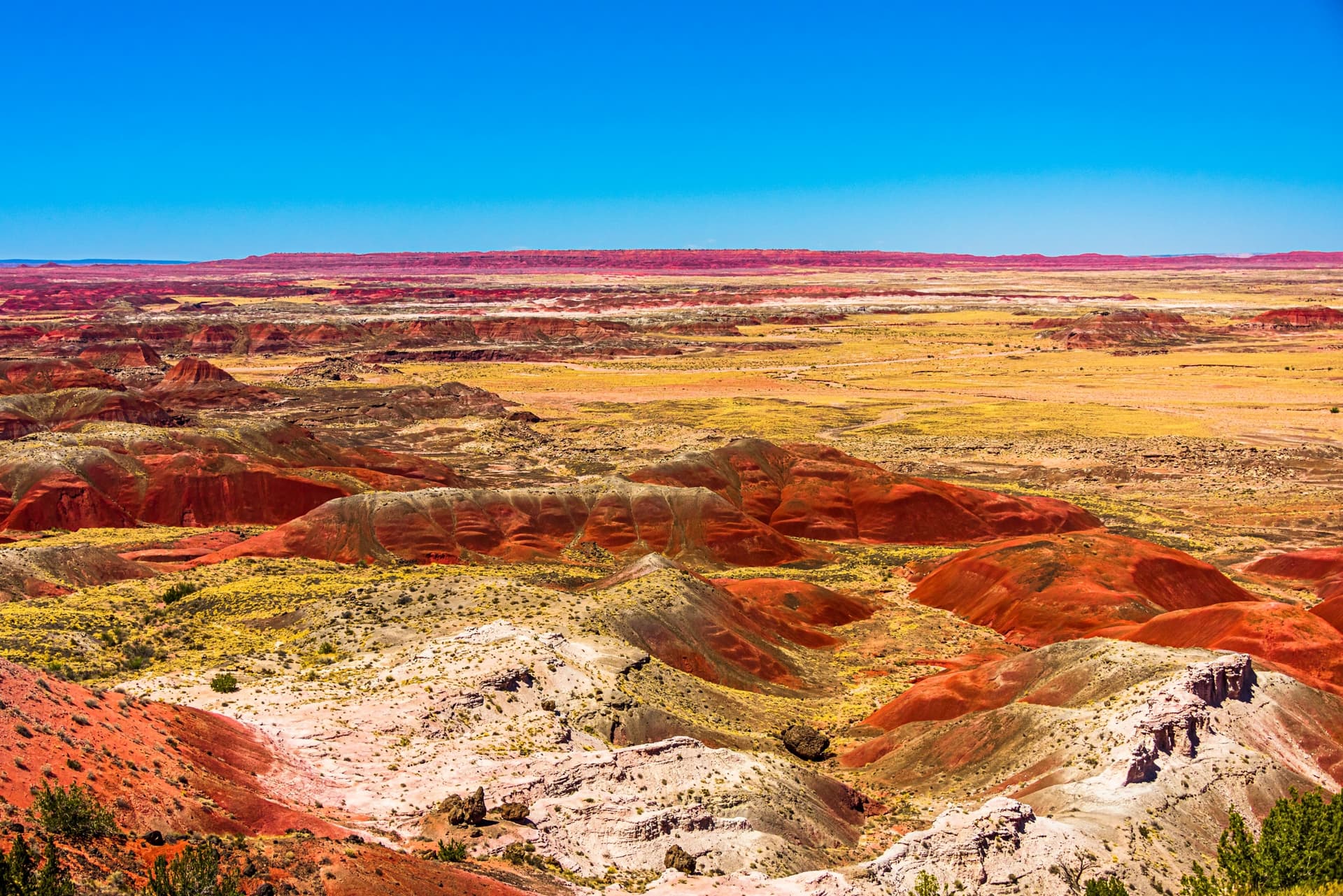
The Painted Desert unfolds its multicolored badlands across northern Arizona, within the Petrified Forest National Park. Striped with red, purple, orange, and gray, its hills owe their hues to iron and manganese contained in layers of clay and sandstone millions of years old. Less visited than the Grand Canyon, this area combines geological landscapes, Native American sites, and Route 66 heritage.
Why Visit Painted Desert?
Painted Desert constitutes the northern portion of Petrified Forest National Park. Unlike the petrified wood zones that bring scientific renown to the park, it offers a purely visual experience: a sequence of badlands whose colors shift with changing light, and a succession of viewpoints connected by a scenic road.
The site's appeal also stems from its cultural significance. It is crossed by Route 66 and connected to the territory of the Navajo Nation. You'll find petroglyphs, the remains of an ancestral village, and a historic inn transformed into a museum. The entire area can be explored in half a day to a full day, depending on your pace and number of stops.
History and Human Settlement
Painted Desert has been a passage and settlement territory for centuries. The Ancestral Puebloans left two major testimonies: the Newspaper Rock petroglyphs, carved into sandstone blocks, and the remains of Puerco Pueblo village, occupied around the 13th century.
In the 16th century, Spanish explorer Francisco Vázquez de Coronado passed through during his expedition through the Southwest. Three centuries later, military engineer Joseph C. Ives studied the region and contributed to its first scientific description.
The 20th century marked the arrival of Route 66, which crossed the area. The Painted Desert Inn, built in the 1920s, became a stop for travelers. Now converted into a museum, it houses the murals by Hopi artist Fred Kabotie, created as part of a renovation program in the late 1940s.
What to See and Do
Blue Mesa
At Blue Mesa, the hills take on bluish and lavender tones that contrast with the surrounding reds. A loop trail descends into the midst of the badlands and allows close observation of eroded strata. The dominant color shifts with the sun's angle.
The Tepees & Devil's Playground
The Tepees form a series of conical buttes striped with red, gray, and purple. The Devil's Playground area, more remote and subject to access regulations, features a chaotic landscape sculpted by erosion.
Painted Desert Inn
Designated a National Historic Landmark, Painted Desert Inn tells the story of the park and Route 66. The wall murals by Hopi painter Fred Kabotie are its most remarkable feature.
Newspaper Rock
Newspaper Rock contains hundreds of petroglyphs depicting animals, hunting scenes, and symbols. Viewing is from an equipped viewpoint with fixed binoculars, as the carved blocks are protected below.
Puerco Pueblo
The Puerco Pueblo site preserves the foundations of a pueblo village occupied around the 13th century. A short, flat trail circles the remains and passes near additional petroglyphs.
The Viewpoints
Five main vantage points dot the park's northern section:
- Kachina Point: located near Painted Desert Inn, offering a broad panorama of the badlands.
- Tawa Point: particularly striking in early morning when the strata are illuminated.
- Pintado Point: one of the highest points, providing an expansive perspective over the entire painted desert.
- Lacey Point: less crowded, peaceful atmosphere.
- Old Route 66 Vista Point: symbolic remnants of the historic road that crossed the park.
The Painted Desert Rim Trail connects several of these viewpoints via a gently rolling path overlooking the badlands.
When to Visit
The park is accessible year-round, but conditions vary significantly by season.
- Spring (March to May): moderate temperatures, desert plant blooms.
- Summer (June to August): intense heat, temperatures frequently exceed 95°F in midday. Prioritize early morning and late afternoon hikes, and bring plenty of water.
- Fall (September to November): the most stable season, with favorable light for photography.
- Winter: cool but pleasant days for walking, occasionally cold nights, occasional snow.
For photography, sunrise and sunset remain the times when badlands colors are most vibrant.
Practical Information
Painted Desert entry is included in your Petrified Forest National Park ticket, valid for several days and priced according to transportation mode (pedestrian, motorcycle, vehicle). The America the Beautiful annual pass is accepted.
The Painted Desert Visitor Center, located at the north entrance, provides maps, trail conditions, and information on permits needed for backcountry zones like Devil's Playground. Opening hours vary by season; check before departing.
Plan a minimum of half a day for the scenic road and viewpoints, a full day if you add Blue Mesa and the park's southern petrified wood section.
How to Get There
The park's north entrance is approximately 25 miles east of Holbrook and 115 miles from Flagstaff, accessible directly from Interstate 40 (Exit 311). A scenic road 28 miles long crosses the park from north to south and connects to US Highway 180, which returns toward Holbrook. No public transportation serves the site: a car is essential.
Nearby Attractions
Painted Desert fits naturally into a broader Southwest itinerary:
- Cadillac Ranch, another iconic Route 66 stop, to the east toward Texas.
- Bryce Canyon National Park, in neighboring Utah, for its hoodoos.
- Canyonlands National Park, further north, for plateau and canyon landscapes.
FAQ
Frequently asked questions
They belong to the same national park, Petrified Forest National Park. Painted Desert corresponds to the northern portion, dominated by colorful badlands; petrified wood concentrates to the south.
Yes, an entrance fee applies to the park and includes access to Painted Desert. The rate depends on transportation mode. The America the Beautiful pass is valid.
Tawa Point and Kachina Point offer the most accessible panoramas from Painted Desert Inn. Pintado Point provides the broadest perspective.
Half a day suffices for the scenic road and main viewpoints. Plan a full day to add Blue Mesa, Newspaper Rock, Puerco Pueblo, and the petrified wood zone.
Yes, certain areas like Devil's Playground are accessible for backcountry hiking, but they require a free permit issued at the Visitor Center.
Planning Your Next Destination
Painted Desert fits naturally into a broader circuit through Southwest parks. To build a custom itinerary incorporating Arizona and Utah, consult our travels in the United States.
Interested in this visit?
We can include it in your personalised itinerary.