Petrified Forest National Park
Petrified Forest National Park
In northeastern Arizona, Petrified Forest National Park brings together fossilized wood dating back 200 million years, ancient petroglyphs, and remnants of Route 66.
In northeastern Arizona, Petrified Forest National Park protects the world's largest concentration of petrified wood, a desert expanse of 440 km² where trunks dating back 200 million years emerge amid landscapes striped with minerals. The park combines geological, archaeological, and historical significance, featuring fossil sites, ancient petroglyphs, and Route 66 remnants.
Why visit Petrified Forest National Park?
The park stands out for the density and quality of its fossilized wood, whose sections polished by erosion reveal crystals in ochre, rust, and violet hues. Beyond the trunks, the site encompasses several layers of interest:
- Around a hundred fossil sites documenting Triassic fauna and flora.
- Traces of ancient civilizations dating back more than 8,000 years, including petroglyphs visible from the trails.
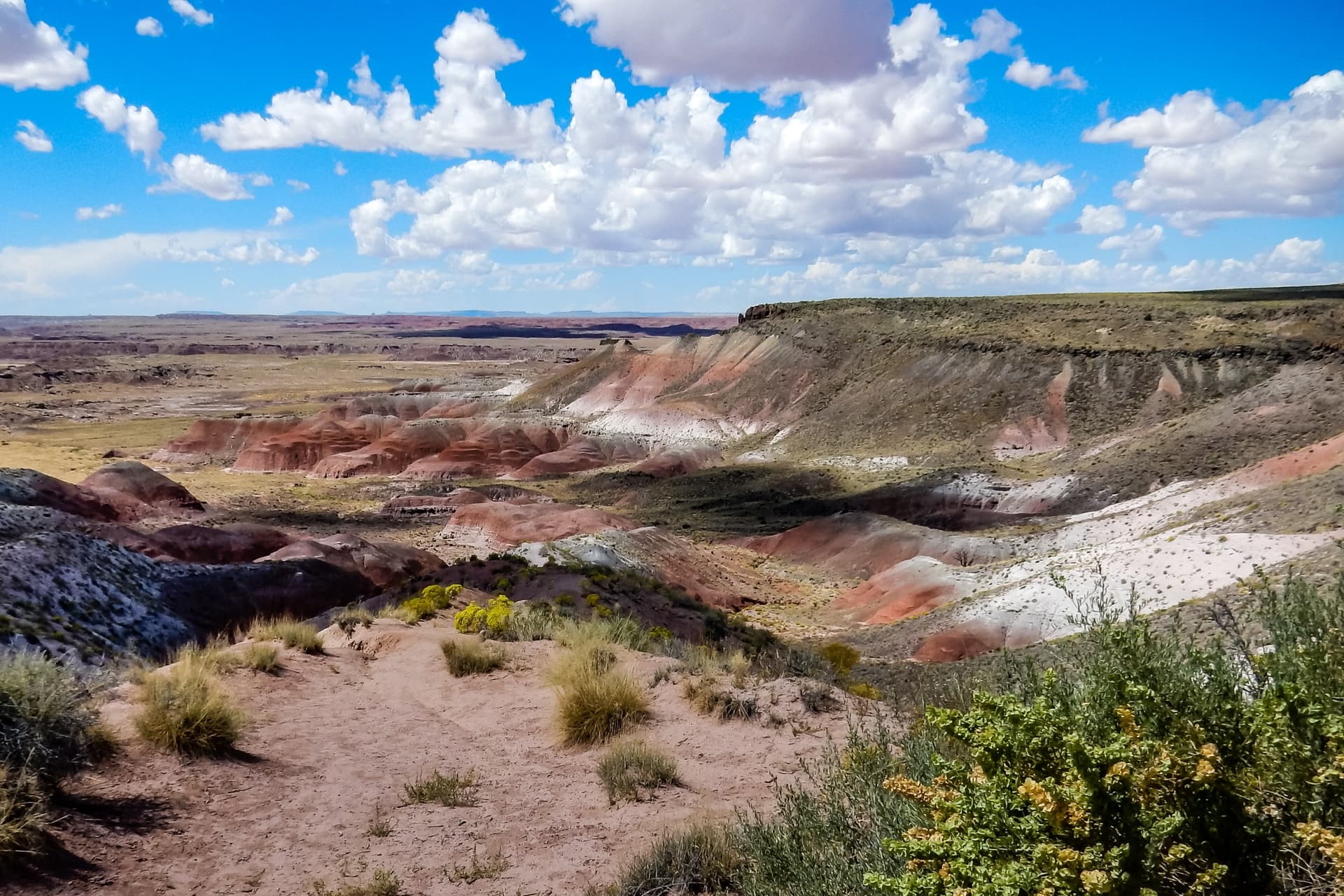
- The Painted Desert, a vast expanse of colored mesas extending the park north of Interstate 40.
- Remnants of Route 66, which once crossed this section of Arizona.
The park's inscription as a UNESCO World Heritage Site in 2008 confirmed its scientific and landscape value.
History of the site
Two hundred million years ago, giant conifers grew in this Arizona territory, then swampy. Major geological changes buried the trees beneath layers of silica-rich earth, causing their gradual fossilization. The movements of the Colorado Plateau, followed by erosion, brought them back to the surface much later.
With the railroad built in the late 19th century, access to the site became more accessible. Collectors and jewelry makers would extract crystals from the trunks, accelerating the deposit's degradation. In the early 20th century, excavations uncovered around a hundred fossil sites as well as traces of ancient civilizations dating back more than 8,000 years.
A first attempt at designation occurred in 1895. The site was declared a National Monument in 1906 by Theodore Roosevelt, became a national park in 1926, and was inscribed as a UNESCO World Heritage Site in 2008.
What to see in the park
A scenic road crosses the park from north to south over about fifty kilometers and serves most points of interest. You can drive it in half a day, or dedicate a full day to it by combining short trails.
Giant Logs and Rainbow Forest Museum
At the southern entrance, the Rainbow Forest Museum features exhibits on wood fossilization and Triassic ecosystems. Just beyond, the Giant Logs trail leads to a concentration of immense rust-colored trunks, among the park's most spectacular.
Blue Mesa, Newspaper Rock and other viewpoints
Several overlooks punctuate the scenic road:
- Blue Mesa: hills striped with blue-gray bands, accessible via a short loop trail.
- Newspaper Rock: rocky panel covered in petroglyphs, viewable from an elevated platform.
- Kachina Point and Tawa Point: expansive panoramas of the Painted Desert.
Painted Desert and Painted Desert Inn
The Painted Desert unfolds on the other side of Interstate 40, in the park's northern section. At the heart of this area, the Painted Desert Inn, a former adobe hotel converted into a museum and bookstore, overlooks the desert from a cliff. At the northern entrance, the Visitor Center screens a film on wood fossilization and provides useful documentation to prepare your visit.
Route 66 remnants
A line of telegraph poles and an abandoned car shell mark the former Route 66 path that crossed the park. It is the only national park in the États-Unis to preserve a segment of this iconic route.
Practical information
- Admission: paid entry by vehicle, valid for several consecutive days. The National Park Service America the Beautiful pass is accepted.
- Duration of visit: allow half a day for the scenic road and main stops, a full day to combine multiple trails.
- Equipment: plenty of water, closed-toe shoes, sun protection, and a windbreaker. No water refill on the scenic road outside visitor centers.
- Important rule: collecting even the smallest fragment of petrified wood is strictly prohibited and subject to fines.
When to visit?
The park is open year-round, but conditions vary significantly by season:
- Winter (November to March): low temperatures, possible rain and snow episodes.
- Summer (June to August): intense heat. July and August correspond to the rainy season (monsoon), with frequent afternoon thunderstorms.
- Winds and sandstorms: possible year-round due to flat terrain and sparse vegetation.
The most comfortable periods for a visit are May, June, and September, with moderate temperatures and generally clear skies.
How to get there
The park has two entrances connected by the internal scenic road:
- Southern entrance: via Route 180, which connects Holbrook (about 40 km to the west) to St. Johns. This is the entrance closest to the Rainbow Forest Museum.
- Northern entrance: directly accessible from Interstate 40, exit 311. This is the most convenient entrance when coming from Albuquerque or Flagstaff.
Holbrook is the most convenient logistics base for visiting the park, with accommodations, gas stations, and restaurants. A car is essential: no public transportation serves the site.
Nearby
The park fits into a broader itinerary across the American Southwest. Several complementary sites are within reach:
- Cadillac Ranch, an iconic pop art installation on Route 66, to the east toward Texas.
- Canyonlands National Park, in neighboring Utah, to extend your desert landscape experience.
- Bryce Canyon National Park, another major stop on the Grand Circle route through Western parks.
Frequently asked questions
Frequently asked questions
Half a day is enough to drive the scenic road and stop at the main overlooks. Allow a full day if you want to combine multiple trails like Giant Logs, Blue Mesa, and the Painted Desert Inn area.
No. Any collection of petrified wood, even the tiniest chip, is strictly prohibited and subject to fines. Certified fragments are sold in approved shops outside the park.
May, June, and September offer the best conditions, with moderate temperatures and little precipitation. July and August, during peak monsoon season, expose you to storms and sandstorms.
No. A car is essential. The most convenient base is Holbrook, about 40 km from the southern entrance, with accommodations and gas stations.
Petrified Forest was designated a National Monument in 1906, became a national park in 1926, and was inscribed as a UNESCO World Heritage Site in 2008.
Incorporating the park into your trip
Petrified Forest fits naturally into a circuit through the American West, between Route 66, Arizona and Utah parks, or New Mexico Pueblos. A one-day stop is sufficient, provided you plan a night in Holbrook or nearby to enjoy the late afternoon light on the Painted Desert.
Interested in this visit?
We can include it in your personalised itinerary.