St. Louis
St. Louis
Saint Louis stands on the west bank of the Mississippi, at the crossroads between the Midwest and the Deep South.
Saint Louis stands on the west bank of the Mississippi, at the crossroads between the Midwest and the Deep South. Once the gateway to the American West, the city blends Beaux-Arts architecture, a musical heritage rooted in blues and jazz, world-class museums, and a reimagined riverfront. The Gateway Arch dominates the skyline; below it, neighborhoods like the Grove and Cherokee Street reveal a city in full renaissance.
Quick Practical Guide
Access: Lambert-Saint Louis International Airport (STL), served by major U.S. carriers; Amtrak (Union Station) from Chicago and Kansas City.
Urban transport: MetroLink network (light rail) connecting the airport to downtown and East Saint Louis.
Recommended duration: 3 to 4 days to cover major sites and several neighborhoods.
Free museums: most major museums in Forest Park (Art Museum, History Museum, Science Center, Zoo) offer free admission.
Best time to visit: April-May and September-October for pleasant weather; summers are hot and humid.
What to See
The Gateway Arch National Park showcases the 192-meter stainless steel arch and an underground museum dedicated to westward expansion. Forest Park, larger than Central Park, houses five major cultural institutions. The Soulard neighborhood preserves its red-brick 19th-century townhouses and covered market. The Hill remains the heart of the Italian-American community, with its restaurants and fine grocers.
History and Context
Founded in 1764 by Pierre Laclède as a French fur-trading post, Saint Louis came under American control in 1804 following the Louisiana Purchase. It became the starting point for the Lewis & Clark Expedition and, in the 19th century, America's fourth-largest city. The 1904 World's Fair and Olympic Games left Forest Park as their legacy. Twentieth-century industrial decline reshaped the city's demographics and architecture.
Highlights of Your Visit
Gateway Arch
Designed by Eero Saarinen and completed in 1965, the arch is the tallest monument in the United States. Tram cars ascend to the summit for panoramic views of the Mississippi and the Illinois plains. The underground museum tells the story of westward expansion in an immersive way.
Forest Park
The 5-square-kilometer park houses the Saint Louis Art Museum (encyclopedic collection, free admission), the Missouri History Museum, the Saint Louis Zoo (one of the country's few free zoos), and the Science Center. Tree-lined paths and ponds make it a favorite leisure spot for locals.
Soulard and the Blues
Soulard is the city's oldest neighborhood. Its farmers' market has operated since 1779. Soulard's bars maintain a live blues tradition; the annual Mardi Gras carnival draws hundreds of thousands of visitors each February.
Cherokee Street
This bohemian thoroughfare in south Saint Louis concentrates independent art galleries, vintage shops, Mexican restaurants, and cafés. It pulses with the creative energy of contemporary Saint Louis.
Cahokia Mounds (Illinois side)
About twenty minutes' drive away, the pre-Columbian site of Cahokia Mounds (UNESCO-listed) preserves the remains of a Native American city that once held up to 20,000 residents around 1100 AD. Essential for understanding the region's deeper history.
Photography Tips
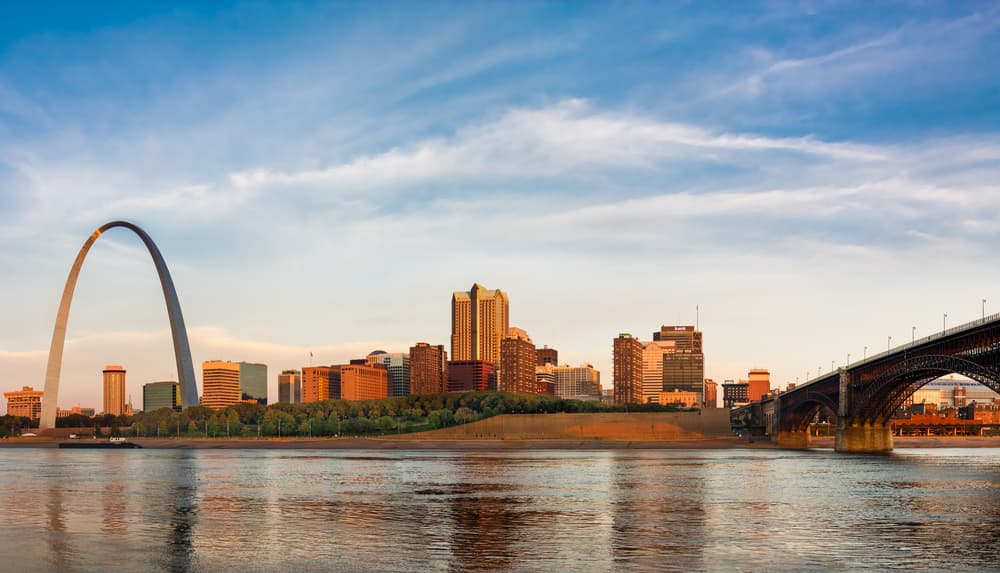
The arch photographs best from the Mississippi's east bank (East Saint Louis, Illinois) in late afternoon, when golden light strikes the stainless steel. To include the river and Eads Bridge in the frame, position yourself on the Riverfront Trail. Within the park, reflections of the arch in the basins at its base offer a less conventional angle. Photos from the arch's summit are permitted.
Location and Access
Saint Louis sits in Missouri at the confluence of the Mississippi and Missouri rivers. Downtown is compact and walkable from Union Station or MetroLink stops. Forest Park lies about 5 kilometers west of Gateway Arch, accessible by light rail (Forest Park-DeBaliviere station). The Soulard and Cherokee Street neighborhoods are south of downtown, best explored by car or bicycle.
For visitors with limited mobility, Gateway Arch National Park has elevators and ramps; Forest Park is largely wheelchair-accessible along its main paths.
Nearby Attractions
Cahokia Mounds — Native American UNESCO site, about twenty minutes' drive on the Illinois side.
Gateway Arch National Park — Saint Louis's iconic monument on the Mississippi riverbank.
Forest Park — the city's green lung, with five museums and cultural institutions.
Soulard — historic red-brick neighborhood, market, and blues scene.
Frequently Asked Questions
Frequently asked questions
Spring (April-May) and fall (September-October) offer pleasant temperatures. Summer is hot and humid; winter can be cold with frost, but the city remains lively.
Yes, the Saint Louis Art Museum, Missouri History Museum, Science Center, and Zoo all offer free admission. Some temporary exhibitions or special attractions may have a fee.
Allow 2 to 3 hours for the underground museum and tram ride to the summit. During peak season, waits for the tram cars are possible.
Saint Louis pairs easily with Chicago (approximately 5 hours by car or Amtrak) or Kansas City (approximately 4 hours by car), forming a coherent Midwest itinerary.
Absolutely. This pre-Columbian site listed as a UNESCO World Heritage Site is about twenty minutes' drive away. Plan half a day for the museum and the ascent of Monks Mound.
MetroLink connects the airport, downtown, and Forest Park. For Soulard or Cherokee Street, a bicycle or rideshare is more practical, as the bus network is limited in the evenings.
Want to discover this destination?
Our local advisors design your tailor-made trip.