New York City
New York City
New York City spans five boroughs — Manhattan, Brooklyn, Queens, the Bronx and Staten Island — at the confluence of the Hudson and East River.
New York City spans five boroughs — Manhattan, Brooklyn, Queens, the Bronx and Staten Island — at the confluence of the Hudson and East River. A global capital of finance, contemporary art and gastronomy, it concentrates within a few square kilometers world-class museums, unparalleled vertical architecture and a cultural diversity that reveals itself in every neighborhood. No other American city offers such density of experiences in a single visit.
Quick essentials
Air access: three airports serve the city — JFK, Newark (EWR) and LaGuardia (LGA).
Urban transit: the MTA subway runs 24/7; buses complement the network. The OMNY card (contactless) is accepted everywhere.
Recommended duration: 5 to 7 days to cover Manhattan's must-sees and explore one or two other boroughs.
Accessibility: variable depending on subway stations; all buses are equipped with ramps. Check the MTA website for accessible stations.
Currency: US dollar (USD); card payment is nearly universal.
Tipping: 18-20% at restaurants and in taxis, common and expected practice.
What to see
Manhattan concentrates the iconic skyline: Art Deco skyscrapers of Midtown, lofts of SoHo, brownstones of Harlem. Central Park offers 341 hectares of greenery in the heart of the island. Brooklyn features the eponymous bridge, galleries of Williamsburg and beaches of Coney Island. The Bronx houses the zoo and Yankee Stadium. Queens combines MoMA PS1 and one of the world's most diverse food scenes.
History and context
Founded in 1626 by the Dutch as Nieuw Amsterdam, the city fell under British control in 1664 and became New York. It served as the first federal capital of the United States from 1785 to 1790. The massive influx of European immigrants between 1880 and 1920 shaped its neighborhoods — Little Italy, Lower East Side, Chinatown — and its pluralistic identity. The twentieth century made it the global center of finance (Wall Street) and contemporary culture.
Highlights of a visit
Central Park
Designed by Frederick Law Olmsted and Calvert Vaux, this 341-hectare park spans Manhattan north to south between 59th and 110th Street. Rowboat lake, Bethesda Fountain, Strawberry Fields: each zone has its own atmosphere. Weekdays see notably less crowding than weekends.
The Metropolitan Museum of Art
The Met, on Fifth Avenue facing Central Park, is one of the world's largest encyclopedic museums. Its collections span five thousand years of art history, from ancient Egypt to contemporary American art. Plan at least half a day; admission is ticketed (suggested price, pay-what-you-wish for New York State residents).
Brooklyn Bridge
Inaugurated in 1883, this suspension bridge connects Manhattan to Brooklyn across approximately 1.8 km. The central pedestrian walkway offers unobstructed views of Lower Manhattan's skyline and the East River. The crossing on foot takes about 30 to 40 minutes.
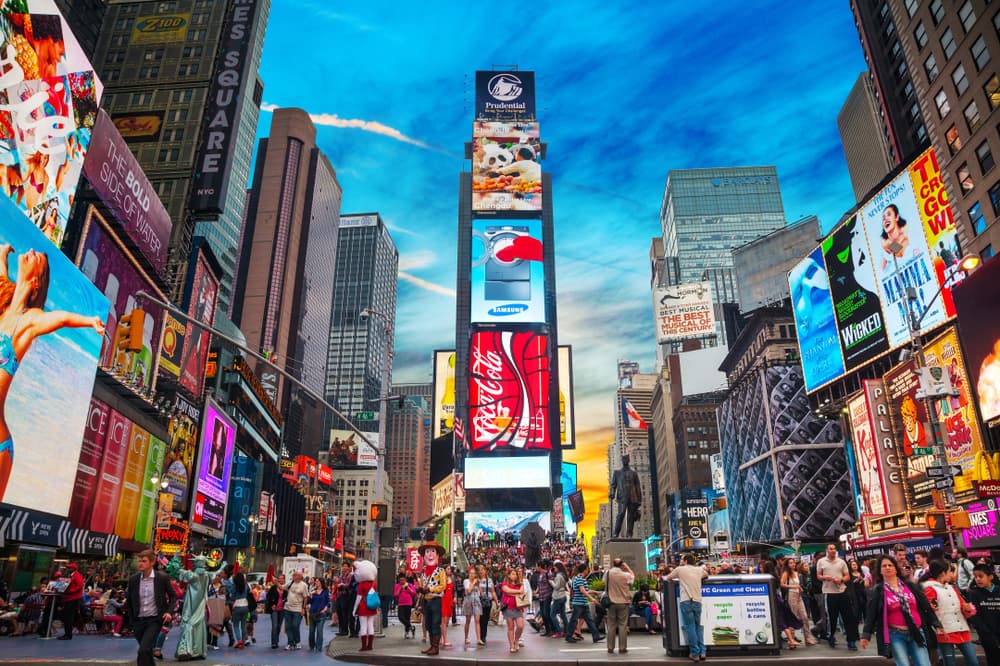
Times Square
The intersection of Broadway and 7th Avenue, Times Square is saturated with illuminated signs and constant human flow. The experience is primarily nocturnal: LED billboards transform night into artificial day. Avoid peak hours (5-7 p.m.) if you wish to move freely.
The American Museum of Natural History (AMNH)
Located west of Central Park on Central Park West, the American Museum of Natural History houses one of the world's largest natural science collections, including the renowned dinosaur hall and the Rose Center planetarium.
The High Line
An elevated former railway converted into a linear park, the High Line runs along Manhattan's west side from Gansevoort Street to 34th Street. Public art, planted gardens and views of the Hudson River make it a distinctive urban promenade.
Photography tips
Manhattan skyline: from Brooklyn Bridge or Brooklyn Bridge Park, golden morning light (just after sunrise) is ideal.
Aerial view: the observatories of the Empire State Building and One World Trade Center offer 360-degree panoramas. Choose the blue hour (20-30 minutes after sunset) to combine city lights with colored sky.
Times Square: at night, a tripod captures the light trails of yellow taxis.
Central Park: autumn (October-early November) offers spectacular foliage; spring (April) brings cherry blossoms near the Reservoir.
Restrictions: commercial photography in municipal parks requires a permit; personal photography is free.
Location and access
New York City is located in New York State on the east coast of the United States. Manhattan is the central island, connected to other boroughs by bridges, tunnels and subway lines. From JFK Airport, the AirTrain + A line subway serves Manhattan in approximately 60 minutes. From Newark, NJ Transit train + Amtrak reaches Penn Station. The city is also accessible by long-distance rail (Amtrak) from Boston, Washington D.C. and Philadelphia.
Nearby
Statue of Liberty — accessible by ferry from Battery Park, this federal monument on Liberty Island is the symbol of American immigration.
Ellis Island — former immigration center (1892-1954), now a museum tracing the arrival of millions of Europeans to the United States.
Coney Island — beach and historic amusement park at the southern tip of Brooklyn, accessible by subway from Manhattan.
Flushing Meadows-Corona Park — large Queens park, site of the 1939 and 1964 World's Fairs, featuring the stainless steel Unisphere.
Bronx Zoo — one of the world's largest urban zoos, home to over 6,000 animals across 107 hectares.
Frequently asked questions
Frequently asked questions
Spring (April-May) and fall (September-November) offer pleasant temperatures and moderate crowds. Summer is hot and very crowded; winter can be cold but December festivities enliven the city.
Five to seven days allow you to cover Manhattan's main sites and explore Brooklyn or Queens. A shorter stay (3 days) requires strict choices between museums, neighborhoods and views.
The MTA subway is the most efficient way to travel. It runs 24/7. The OMNY card (contactless payment by bank card or smartphone) simplifies access without buying a separate ticket.
For the Met, MoMA or AMNH, online booking avoids queues, especially in high season. Some observatories (Empire State Building, One World Observatory) offer time slots to reserve.
Amtrak connects New York to Boston (approximately 4 hours), Philadelphia (1 hour 15 minutes) and Washington D.C. (3 hours) without going through an airport. These cities combine easily in a 10 to 14-day East Coast circuit.
Most major New York museums allow personal photography without flash in their permanent collections. Temporary exhibitions may have specific restrictions, indicated on-site.
Want to discover this destination?
Our local advisors design your tailor-made trip.