Death Valley
Death Valley
Death Valley stretches across California and Nevada, in the heart of the Mojave Desert. It is the lowest point in North America — 282 feet below sea level at Badwater Basin
Death Valley stretches across California and Nevada, in the heart of the Mojave Desert. It is the lowest point in North America — 282 feet below sea level at Badwater Basin — and one of the hottest places on the planet. Salt flats, dunes, colorful canyons, and volcanic craters unfold across more than 13,000 km². A national park on a scale uniquely American.
Quick Facts at a Glance
Admission: fee-based — vehicle pass valid for 7 days (America the Beautiful Pass accepted)
Access: car strongly recommended; from Las Vegas ~2 hours, from Los Angeles ~4 hours
Hours: park open 24/7, 365 days a year; some visitor centers close in summer
Recommended duration: 2 to 3 days to cover the major sites
Best time to visit: October to April — summer temperatures regularly exceed 122°F
Fuel: fill up before entering; gas stations inside are rare and expensive
Water: bring a minimum of 1 gallon per person per day for hiking
Wheelchair accessibility: Badwater Basin, Zabriskie Point, and Furnace Creek Visitor Center are wheelchair accessible
What You'll See
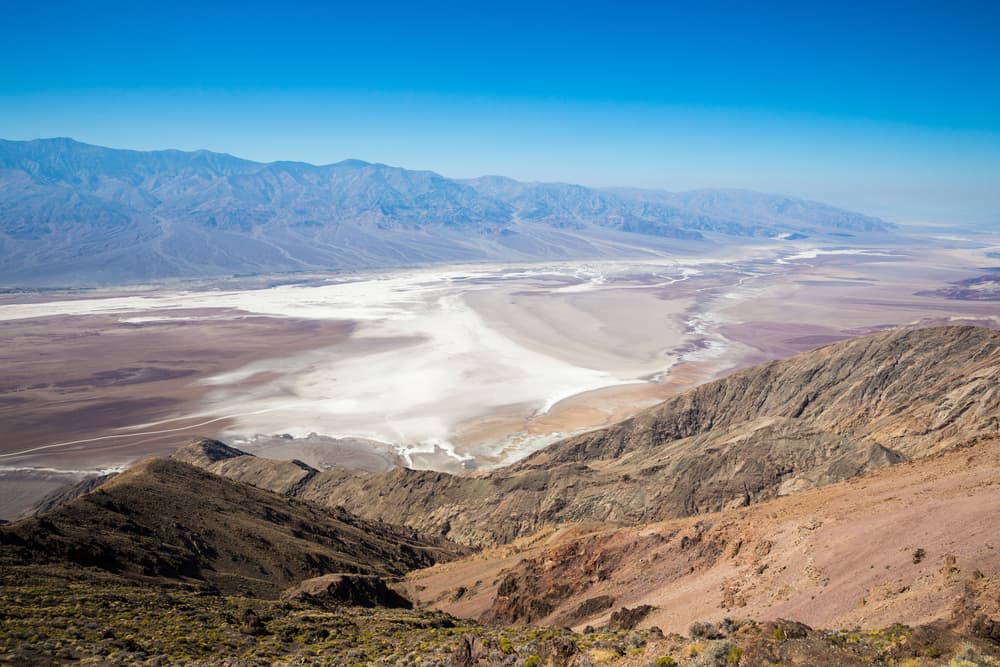
The park concentrates a rare geological diversity. The salt flats of Badwater Basin form a white mirror stretching to the horizon. The Mesquite Flat Dunes reach 100 feet in height. Zabriskie Point offers views over ochre and golden badlands sculpted by erosion. Ubehebe Crater, of volcanic origin, plunges nearly 650 feet deep. Artist's Drive crosses hills tinted green, pink, and purple by mineral oxides.
History and Context
The name "Death Valley" dates to the winter of 1849–1850, when gold prospectors crossed the valley attempting to reach California. Several perished. The Timbisha Shoshone people have inhabited the region for millennia and still live there today. The national park was established in 1994, succeeding the national monument created in 1933. It is designated a UNESCO World Heritage site as part of the Mojave Desert park network.
Highlights of Your Visit
Badwater Basin
At 282 feet below sea level, this salt basin is the lowest point in North America. The salt crust forms natural geometric polygons. Early morning light reveals textures and reflections beautifully. Absolutely avoid visiting midday during summer.
Zabriskie Point
This overlook commands a labyrinth of badlands in warm hues. Dawn is particularly spectacular here: ridges ignite before the sun is even visible. Expect a short walk from the parking area.
Mesquite Flat Dunes
The park's only extensive sand dunes, accessible from the main road. Ideal at sunrise or sunset for interplay of shadows. Walking on soft sand is physically demanding.
Dante's View
At over 5,200 feet elevation, this viewpoint embraces the entire valley, from Badwater Basin to the snow-capped Panamint Mountains. The access road is long but paved. Bring a warm layer, even in summer.
Scotty's Castle
This Spanish-Moorish villa from the 1920s, built by a millionaire and a legendary con artist, is one of the park's historical curiosities. Check its status before visiting — restoration work has limited access in recent years following flood damage.
Photography Tips
Golden hour and sunset light transform every landscape. Zabriskie Point at dawn and Badwater Basin at dusk are the two must-visit spots for photographers. Mesquite Flat Dunes photograph best in late afternoon when shadows carve the ridges. Avoid midday: the light is harsh and temperatures dangerous. A polarizing filter reduces glare on the salt flats.
Location and Access
The park spans California and Nevada. The hub is Furnace Creek, home to the visitor center, a historic hotel (The Inn at Death Valley), and basic services. From Las Vegas, allow about 2 hours via US-95 then NV-373. From Los Angeles, the most direct route via CA-14 and US-395 is about 4 hours. No public transit serves the park — a car is essential. Certain tracks (Racetrack Playa, Eureka Dunes) require four-wheel-drive.
Nearby Attractions
Las Vegas Strip — roughly 2 hours east, for a striking contrast with the desert.
Joshua Tree National Park — another California desert, about 3 hours south, famous for its Joshua trees and rock formations.
Sequoia National Park — about 3.5 hours west, moving from the lowest point to the world's tallest tree.
Mono Lake — salt lake with tufa formations, about 2.5 hours northwest.
Frequently Asked Questions
Frequently asked questions
October to April. Temperatures are comfortable, even chilly at night. In February and March, wildflowers may bloom if winter rains were sufficient. Summer is dangerous: ground temperatures regularly exceed 122°F.
It's possible but limited. One day allows you to see Badwater Basin, Zabriskie Point, and Mesquite Flat Dunes. For Dante's View, Scotty's Castle, or remote tracks, plan at least two nights on-site.
Not for the main sites, all accessible by standard vehicle. Four-wheel-drive is necessary only for unpaved tracks like Racetrack Playa or Eureka Dunes.
Yes, personal photography is allowed anywhere in the park. Commercial photography requires a permit from the National Park Service.
Yes. The Inn at Death Valley (formerly Furnace Creek Inn) and The Ranch at Death Valley offer rooms. Campgrounds are also available, some requiring reservations, others on a first-come, first-served basis.
Carry a minimum of 1 gallon of water per person per day. Avoid walking between 10 a.m. and 4 p.m. in warm season. Tell someone your planned route. Mobile coverage is virtually nonexistent across most of the park.
Want to discover this destination?
Our local advisors design your tailor-made trip.