Meteor Crater
Meteor Crater
A 1.2 km impact crater in Arizona, formed 50,000 years ago and used by NASA to train Apollo 11 astronauts.
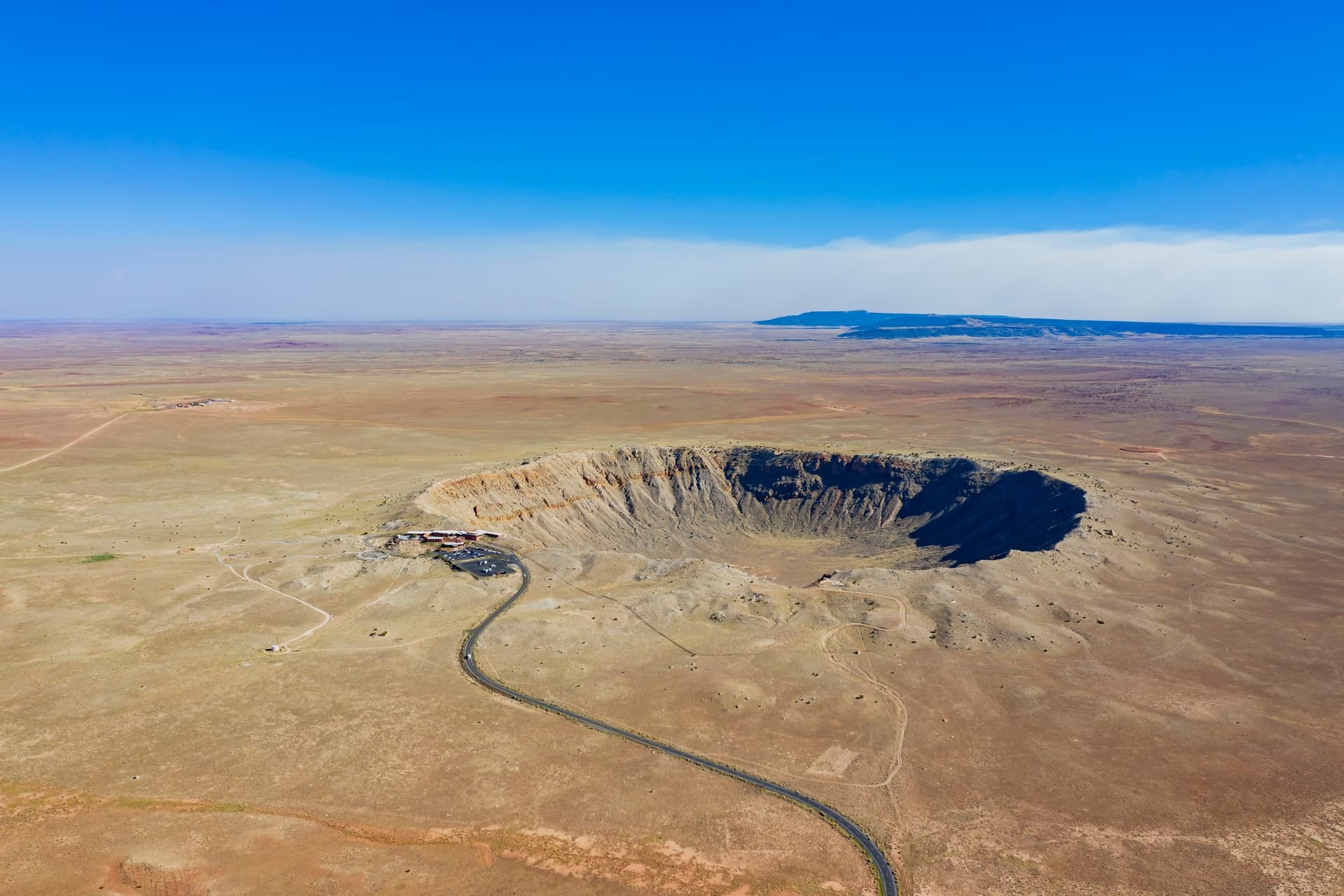
The Meteor Crater is an impact crater 1.2 km in diameter and 180 meters deep, located in northern Arizona, between Flagstaff and Winslow. Regarded as the world's best-preserved impact site, it bears witness to a collision that occurred approximately 50,000 years ago and served as a training ground for the Apollo 11 astronauts.
Why visit Meteor Crater
Three factors make this site remarkable. First, its state of preservation: Arizona's arid climate has protected the crater from erosion, allowing observation of an almost intact depression with exposed rock layers dating back more than 250 million years. Second, its scientific significance: this is where the cosmic origin of terrestrial impact craters was first demonstrated, in 1960. Finally, its connection to space history: the site hosted training for Neil Armstrong, Buzz Aldrin, and Michael Collins before the Apollo 11 mission, and the training capsule used at the time is displayed at the entrance to the Visitor Center.
The crater's formation 50,000 years ago
The crater, also known as Barringer Crater, formed when a meteorite 45 meters in diameter weighing approximately 300,000 tons and composed mainly of iron struck the earth. Its entry speed is estimated between 15 and 30 km/s, corresponding to energy released equivalent to 150 times that of the Little Boy bomb at Hiroshima.
The explosion ejected approximately 175 million tons of material, including limestone blocks 30 meters across. The impact's heat vaporized part of the rock and created rare minerals such as diamond and lonsdaleite. A fireball reached 10 km in height and the pressure wave propagated at approximately 2,000 km/h. The resulting earthquake is estimated at a magnitude of 5.5.
At that time, the region was a wooded savanna inhabited by woolly mammoths and giant ground sloths. The local ecosystem was devastated by the blast, but the event had no consequences on a planetary scale.
The discovery story
The crater was spotted in 1871 by U.S. Army surveyors, but its nature remained long debated. In 1896, geologist Grove Karl Gilbert concluded, in the absence of evidence of iron on the surface, that it had a volcanic origin.
The meteoritic hypothesis was advanced in 1902 by Daniel Moreau Barringer, a mining engineer convinced that an enormous block of iron and nickel lay buried beneath the depression. He purchased the land in 1903 and spent 27 years searching for the metal mass, without success — the meteorite had in fact largely vaporized on impact.
It wasn't until 1960 and the work of geologist Eugene Shoemaker that the cosmic origin was definitively proven, through the identification of minerals that can only form under extreme pressure. This demonstration marked a turning point in the study of terrestrial impact craters.
What to see and do
Observation platforms and rim trail
Three panoramic platforms offer different angles on the depression. A trail follows a portion of the rim and allows observation of the overturned rock strata and blocks ejected during the explosion. Guided tours lasting approximately half an hour are available on-site to place the site in its geological context.
The Visitor Center and its museum
The Visitor Center houses a museum dedicated to the site's history, the Barringer family, and the main impact craters documented on Earth. Interactive exhibits explain collision mechanics and display meteorite fragments recovered on-site. A 4D projection theater offers a reconstruction of the impact, suitable for families.
The Apollo 11 training capsule
On display at the entrance, this capsule recalls the role the crater played in preparing for the lunar mission of July 1969. NASA selected the site for its terrain comparable to certain areas of the Moon and trained the three crew members there.
The site's gift shop
The shop offers specialized books, authenticated meteorite fragments, and thematic items related to astronomy and space exploration.
Practical information
Meteor Crater is private property managed by Meteor Crater Enterprises and the Barringer family. The America the Beautiful Annual Pass is therefore not accepted, unlike most U.S. national parks. Tickets can be purchased online or directly at the entrance. Plan to spend approximately 1.5 to 2 hours on-site to enjoy the museum, platforms, and a guided tour.
The site is open daily, with extended hours in summer (high season) and more limited hours the rest of the year. Check current opening times on the official website before your visit.
When to visit
The climate is desert-like with significant temperature variations. The months of spring (April-May) and fall (September-October) offer the most comfortable conditions, with moderate temperatures and generally clear skies. Summer is very hot, sometimes exceeding 35°C at midday, and intense light makes the platforms unwelcoming in early afternoon: prioritize morning opening hours. Winter can be cold and windy, with temperatures near freezing in the morning, but offers excellent visual clarity over the depression.
How to get there
The crater is located 56 km east of Flagstaff and 19 km west of Winslow. From Interstate 40 (I-40), take exit 233 (Meteor Crater Road), then continue approximately 6 miles south to the Visitor Center. A car is essential: no public transportation serves the site.
Meteor Crater fits naturally into an itinerary between Las Vegas, the Grand Canyon, and eastern Arizona, following the historic Route 66 that passes through Winslow and Flagstaff.
Nearby attractions
Several stops complement a visit pleasantly:
- Winslow (19 km): a small Route 66 town famous for its intersection referenced in the Eagles' song Take It Easy.
- Flagstaff (56 km): a convenient stop-over town with its Lowell Observatory where Pluto was discovered in 1930.
- Petrified Forest National Park (approximately 1.5 hours by car to the east): fossilized forest and the colorful badlands of the Painted Desert.
- Walnut Canyon and Sunset Crater (near Flagstaff): natural and archaeological sites less crowded.
To continue toward other spectacular parks, Bryce Canyon National Park and Canyonlands National Park are located further north in Utah. On Route 66, the photogenic stop at Cadillac Ranch in Texas fits into the same road trip logic.
FAQ
Frequently asked questions
The site is private property of the Barringer family, operated by Meteor Crater Enterprises. This is why the America the Beautiful Annual Pass is not accepted.
Convinced that a massive block of iron and nickel rested beneath the depression, he hoped to extract it and make his fortune. He devoted 27 years to drilling, but never recovered the mass he sought — the meteorite had largely vaporized on impact.
No. Access to the bottom is prohibited for safety and preservation reasons. Visits are conducted from the observation platforms and the managed trail along the crater rim.
Plan 1.5 to 2 hours to combine the platforms, Visitor Center museum, and a guided tour. A half-day allows you to add a stop in Winslow or Flagstaff.
Yes. Interactive exhibits, 4D projection, and the Apollo 11 capsule generally appeal to families. Bring hats, water, and sunscreen: the platforms offer little shade.
Add Meteor Crater to your trip
A natural stop between the Grand Canyon and the New Mexico border, Barringer Crater fits into most southwestern United States road trips. To build a customized itinerary in the region, consult our travel to the United States.
Interested in this visit?
We can include it in your personalised itinerary.