Capitol Reef National Park
Capitol Reef National Park
In the heart of Utah, Capitol Reef reveals red canyons, white sandstone domes, and historic orchards. Your complete guide to planning the perfect visit.
Red canyons, stone arches, granite domes rising defiantly toward the heavens… The geologic landscape of Capitol Reef delights adventurers of all ages. A park waiting to be discovered at the heart of Utah.
Planning a journey through Utah? Seeking a family or group hike? Capitol Reef National Park is an excellent choice. Utah's landscape has earned its reputation, thanks to its rock formations sculpted by eons of erosion, as an endless chain of protected lands. Capitol Reef holds distinctive features. Following a buckling of the earth's crust that occurred 40 to 50 million years ago, majestic sandstone domes emerged, adorning the Waterpocket Fold mountain range. Beyond the cliffs stretches a succession of landscapes: lakes, rivers teeming with trout, desert plains, narrow colorful gorges, and valleys framed by arches and limestone spires. Opportunities for hiking, climbing, and camping are endless within the park's boundaries. Dedicate an entire leg of your journey to exploring Capitol Reef's treasures, and you'll fulfill your wildest Far West adventure fantasies.
Capitol Reef by the Numbers
- Capitol Reef National Park was officially established in 1971.
- Its total area spans approximately 979 km².
- Cathedral Valley is home to the park's highest peak, exceeding 2,500 m elevation.
- The lowest zone, at Halls Creek, hovers around 1,200 m.
- It features 320 km of marked trails.
- More than 300 animal species inhabit the park (invertebrates excluded), with approximately 900 plant species.
Where Is Capitol Reef National Park Located?
Capitol Reef's untamed wilderness sits in the heart of Utah, a southwestern state in the United States. Considerable driving is required to encounter this natural heritage. Las Vegas airport, the closest to Capitol Reef's visitor center, lies over 500 km away. The drive from Salt Lake City spans 500 km, versus 600 km from Denver. This physical isolation likely explains the park's relatively modest annual visitation: approximately 1.2 million visitors—respectable, certainly, but tiny compared to the Grand Canyon's 5.9 million. Nevertheless, Capitol Reef National Park ranks among America's finest ecotourism destinations, alongside Canyonlands, Arches, and Bryce Canyon.
No public transportation serves the park entrance. A private vehicle is your only option. Three highways provide access: Interstate 70, Interstate 15, and the scenic Utah State Route 12.
Geologic History of the Park
Capitol Reef's rugged landscape emerged from a tumultuous geologic past. Seventy million years ago, the Laramide orogeny triggered a tectonic fault that displaced rock layers to elevations exceeding 2,100 m. This gave rise to an enormous mountain ridge known as the "Waterpocket Fold." It dominates vast sections of the park across more than 160 km of its length.
Capitol Reef forms an integral part of the Waterpocket Fold—its most accessible section. The sandstone blocks gleam with such brilliant whiteness they resemble the dome of the Capitol, the U.S. Parliament building. Moreover, these colossal sandstone domes derive from the erosion of an ancient coral reef, from an era when oceans flooded the entire region. This is why the park earned its name: "Capitol Reef." Year after year, erosion worked its magic. The landscape became dotted with canyons, sandstone cliffs, hoodoos, fairy chimneys, and countless red arches.
Diverse Activities for Every Taste
To enhance your group or family excursion at Capitol Reef, a wealth of activities awaits:
Jeep Tours Through the Canyons
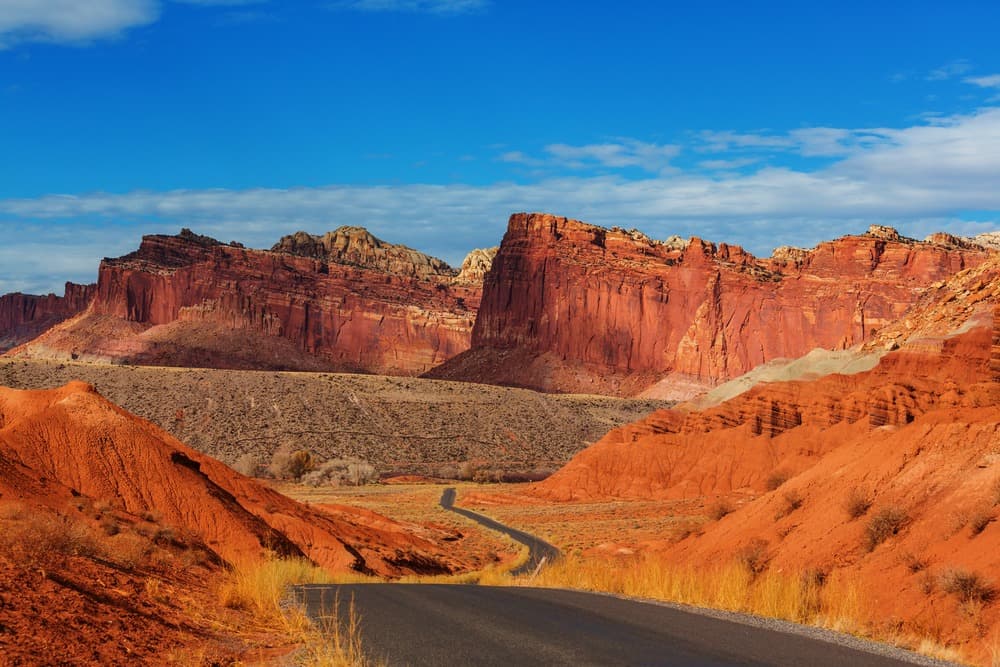
Travelers love traversing Utah State Route 12, which connects Capitol Reef National Park to Bryce Canyon National Park. Thirteen kilometers of this scenic stretch wind through the park's boundaries. How beautifully sinuous this road is! Rocky plateaus, deep gorges, and red sandstone formations with fantastical shapes (Cassidy Arch) compose a breathtaking landscape.
Beyond this paved route lie two exceptionally popular trails: Grand Wash and Capitol Gorge. Though unpaved, both are drivable and lead into spectacular canyons. These routes accommodate passenger vehicles longer than 8 meters. The grade remains modest.
Camping Under the Stars
An oasis in the desert, Fruita village offers camping pleasures. Luxury tent accommodations become even more enchanting nestled among fruit trees. Quality bedding, bathrooms, and flush toilets are provided. For a rustic immersion and true communion with nature, set your sights on the Cathedral Valley or Cedar Mesa campsites.
Experience an Unforgettable Hike
Pleasant Creek:
This easy trail suits everyone. You follow a small stream leading into a narrow, winding gorge. Most of the time the creek can be crossed on foot, but prepare to swim through deeper sections. Plan a full day for this hike.
Spring Canyon, Lower Twist Muley Canyon, Upper Twist Muley Canyon:
These three routes prove slightly more challenging than Pleasant Creek, but the spectacle of twisting canyon fissures justifies the effort. Plan a day hike or overnight for each trail.
Halls Creek, Sheets Gulch, Cottonwood, Burro:
Abrupt and highly technical terrain awaits hikers on these trails. Difficulty is substantial. Only experienced walkers should attempt them.
Bird Watching
Campers and hikers aren't the only ones having a field day. With a robust bird population, Capitol Reef captivates ornithologists. Common species include the American kestrel, rufous hummingbird, black-chinned hummingbird, broad-tailed hummingbird, western kingbird, and gray-blue flycatcher—the latter capturing prey mid-flight.
Outdoor Activities: Rock Climbing, Horseback Riding, Mountain Biking, Fishing, Canyoneering…
Capitol Reef's extremely mountainous terrain excels for cycling, rock climbing, and paragliding. Trout and brook trout fishing is popular on the Fremont River and the high-altitude lakes of Boulder Mountain.
Want to saddle up? Head to the Post Corral riding center. Mount your choice of burro, mule, or sorrel mare. Ride along Halls Creek, ascend the forested slopes of Boulder Mountain, venture toward Cathedral Valley, and enjoy stunning views of the cliffs.
Essential Information Before You Go
When to Visit the Park?
While spring offers perfect conditions—mild temperatures, flowering trees, and bird mating displays—Capitol Reef welcomes visitors year-round in winter (December to February) and fall (September to November). Summer is best avoided due to flash floods and rainstorms that make hiking unpleasant.
What About Entrance Fees?
Visitors must obtain an entry permit issued by park rangers. Fees are $10 for pedestrians or cyclists, $15 for motorcycles, and $20 for automobiles. Your pass is valid for 7 days.
Where to Eat?
If camping isn't your style, lodging and dining services operate outside the park boundaries. Local farmers from neighboring rural communities manage these services, depending largely on tourist traffic for their livelihood.
Want to discover this destination?
Our local advisors design your tailor-made trip.