Hawaii
Hawaii
Active volcanoes, legendary waves and Polynesian culture: Hawaii unites six principal islands with distinct personalities, waiting to be explored island by island.
Hawaii… The name alone sparks dreams! This emblematic archipelago, often glimpsed in American films, is far more than a postcard. Here, magnificent volcanoes, legendary waves, coconut-fringed beaches and crystalline lagoons create an ideal backdrop for adventure and relaxation alike. Add to this a rich and authentic culture, and you have one of the Pacific's greatest jewels. Ready to dive into this paradise? Discover its best attractions in this guide.
The archipelago's history in brief
Hawaii was born millions of years ago following intense underwater volcanic activity, a phenomenon that continues today. Discovered and settled by Polynesians around 300 to 600 A.D., it was unified by King Kamehameha I in 1795, with European support. For over a century, sugar cane plantations dominated the local economy.
Becoming a republic in 1894, Hawaii was annexed as United States territory in 1898. It played a major strategic role, as evidenced by the attack on the Pearl Harbor naval base on December 7, 1941. In 1959, the archipelago officially became the 50th American state.
Today, Hawaii's population stands at 1.446 million inhabitants. 12.5% declare themselves to be of Polynesian origin. The archipelago's economy rests primarily on tourism, agriculture (notably pineapple, sugar cane and coffee), military activities (American bases) and services.
Tourism in Hawaii, the must-sees
The Hawaiian archipelago comprises 137 islands, islets and atolls, but only a few are inhabited and accessible. We invite you to discover the principal islands (Oʻahu, Maui, Hawaii, Kauai, Molokai and Lanai), which concentrate the essential sites.
Oʻahu
Oʻahu is considered the heart of Hawaii. The island captivates with its blend of ancestral traditions and vibrant modernity. It also delights with its mythical beaches, historic sites and breathtaking landscapes.
- Waikiki Beach
At Waikiki Beach, everything invites relaxation: clear waters, golden sand and festive atmosphere. This is where modern surfing was born, popularized by the legendary Duke Kahanamoku in the 1910s. The beach is perfect for beginners.
- Diamond Head
Climb Diamond Head, one of the archipelago's most famous volcanoes. This crater, 300,000 years old and once used as a strategic military post, offers a spectacular panoramic view over Honolulu, the state capital, and the Pacific Ocean.
- Pearl Harbor
Immerse yourself in an important chapter of world history by visiting Pearl Harbor. The USS Arizona Memorial will transport you back to 1941, the attack that brought the United States into World War II. Also take time to explore the USS Bowfin Submarine Museum or the Battleship Missouri Memorial to better understand the historical impact of these events.
- North Shore
Looking for thrills? Don't miss Oʻahu's North Shore, the mecca of world surfing. In winter, gigantic waves attract the planet's best surfers. During summer, the waters calm and become ideal for swimming and snorkeling.
- Hanauma Bay
Don your mask and snorkel, and marvel at the incomparable underwater beauty of Hanauma Bay. Designated a nature reserve, this bay protects incredible biodiversity including vibrant corals and fascinating tropical fish.
Maui
Nicknamed "the valley isle," Maui is renowned for its contrasting landscapes, between majestic volcanoes and dreamlike beaches.
- Road to Hana
Venture onto one of the world's most legendary roads, the Road to Hana. Over nearly 100 kilometers, you'll wind through 620 turns and cross 59 bridges. Stop to explore hidden waterfalls, lush tropical forests and black sand beaches like Waianapanapa.
- Haleakalā National Park
Experience a celestial adventure by ascending to the volcano's summit in this park. The sunrise from the crater offers a surreal spectacle, sometimes compared to a journey to Mars.
- The town of Lahaina
Discover Maui's historic soul by strolling through Lahaina, once Hawaii's royal capital. This port town, once the heart of the whaling industry, today houses superb art galleries and artisan shops.
- Kaanapali and Wailea beaches
Succumb to the charms of Kaanapali and Wailea beaches, two of Maui's finest. At Kaanapali, at sunset, witness the cliff-diving ritual from Black Rock, paying homage to Hawaiian warriors. At Wailea, savor the serenity of an elegant shoreline, perfect for relaxing by crystalline waters.
- Snorkeling at Molokini
Embark for Molokini, a crescent-shaped volcanic crater half-submerged in the ocean. This snorkeling site captivates with its exceptionally clear crystalline waters, offering up to 45 meters of visibility.
Hawaii Island
From black sand beaches to snow-capped summits, Hawaii Island, the archipelago's largest, surprises with the diversity of its landscapes.
- Hawaii Volcanoes National Park
Dive into the heart of telluric forces by exploring Hawaii Volcanoes National Park. You'll see Kīlauea, one of the world's most active volcanoes. Follow marked trails to observe solidified lava fields, ancient lava tubes and, if fortune smiles, incandescent lava flows illuminating the night.
- Mauna Kea
Get closer to the stars at Mauna Kea's summit, Hawaii's highest point (4,207 meters altitude). This dormant volcano is a privileged site for astronomical observation thanks to its clear, unobstructed sky.
- Black sand beach (Punaluʻu)
Lay your towel on the famous Punaluʻu beach, where volcanic black sand magnificently contrasts with the blue ocean. It's not uncommon to observe green sea turtles basking in the sun, a sight typical of the island.
- Snorkeling at Kealakekua Bay
Explore the turquoise waters of Kealakekua Bay to admire its superb corals and colorful fish. This is where Captain James Cook first landed in 1779.
- Hilo and its waterfalls
Let yourself be seduced by Hilo, a tropical city famous for its regular downpours. Among its best attractions are the Rainbow Falls and Akaka Falls waterfalls, accessible via short, easy trails; and the Hilo farmers market, where you can taste local exotic fruits.
Kauai
Called the "garden isle," Kauai unfolds some of the archipelago's wildest and most spectacular landscapes. Prepare yourself for a complete immersion in nature.
- Na Pali
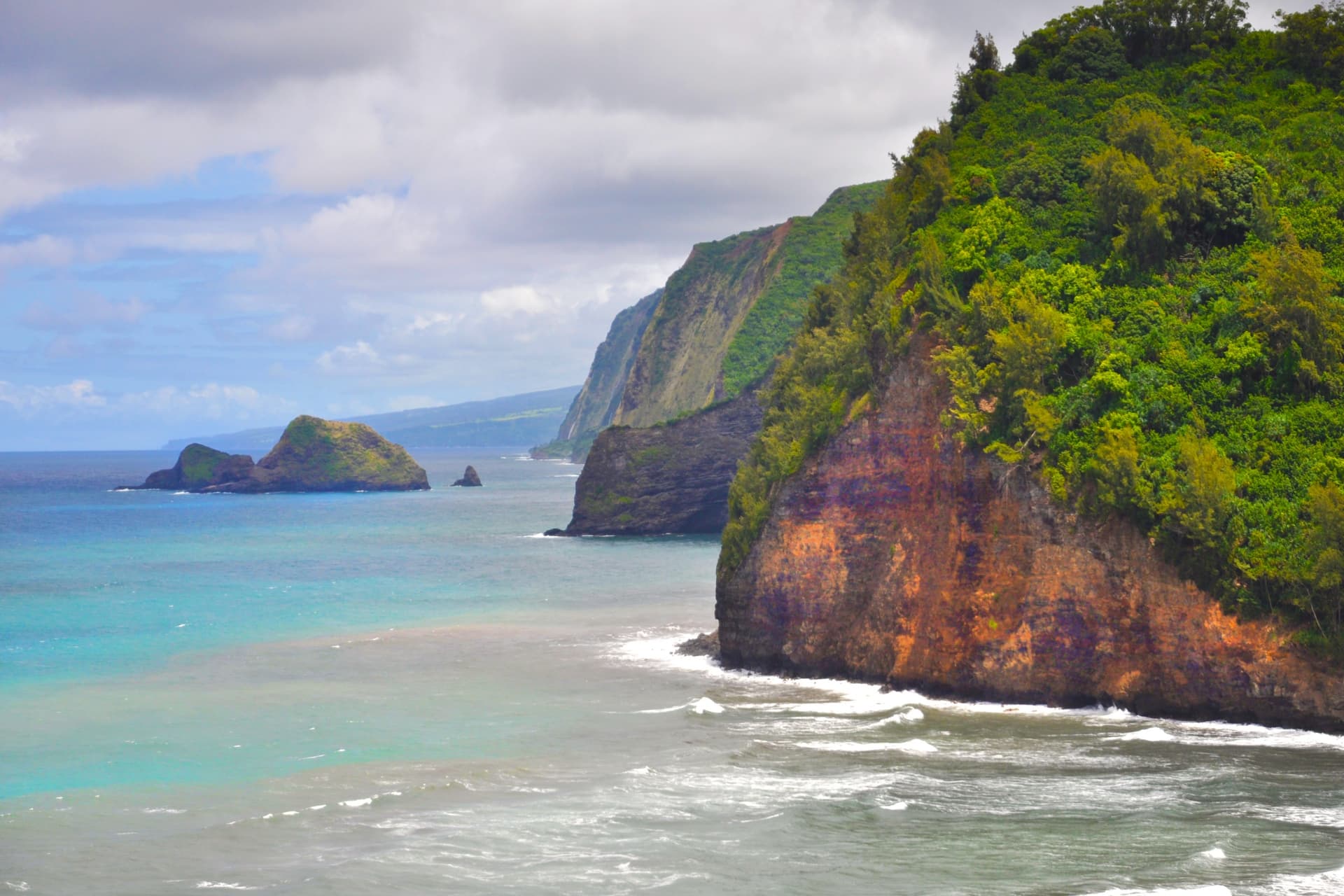
Na Pali is a coast of vertiginous cliffs. The Kalalau Trail, which hugs these majestic landscapes, is reserved exclusively for experienced hikers.
- Waimea Canyon
Behold the "Grand Canyon of the Pacific," a spectacular gorge 16 kilometers long and 900 meters deep. From the various viewpoints of Waimea Canyon State Park, you'll feast your eyes on breathtaking vistas of its walls striped in red, green and ochre.
- Hanalei Bay
Relax on the vast crescent-shaped beach of Hanalei Bay, bordered by verdant mountains. It's the ideal spot in Kauai for a peaceful swim or to test your surfing skills on beginner-friendly waves.
- Wailua River
Paddle down Hawaii's only navigable river. By kayak or paddle board, you'll head upstream along this waterway to the sacred Wailua Falls or to the historic village of Kamokila. The excursion will immerse you in the island's spiritual history, once the heart of Hawaiian royalty.
Other islands (Molokai and Lanai)
Eager to venture off the beaten path? The islands of Molokai and Lanai promise exceptional experiences, far from the crowds.
- Molokai
Immerse yourself in old-time Hawaii on Molokai, nicknamed the "friendly isle." Here, no skyscrapers or massive resort complexes. The Kalaupapa National Historical Park is a moving site that tells the story of lepers exiled in the 19th century. The Kahiwa Falls, meanwhile, are the world's highest sea cliffs, with an average height of 660 meters.
- Lanai
Savor the unique atmosphere of Lanai, where nature and understated luxury coexist. Rent a 4x4 to explore its wild trails to Shipwreck Beach or venture diving with dolphins at Hulopoe Bay, a protected cove ranked among America's finest beaches. Lanai will give you the impression of having an island nearly to yourself.
Practical information
What season to visit Hawaii?
Hawaii can be visited year-round thanks to its pleasant tropical climate. However, favor the months of April, May, September and October, which are less crowded, with dry weather favorable for hiking and water activities.
From the continental United States
Hawaii is connected to major American cities like Los Angeles, San Francisco, Seattle and Dallas.
From France
From Paris, there are no direct flights. You'll need to make a connection in the United States, often in Los Angeles or San Francisco. Total travel time ranges from 18 to 24 hours, including the stopover.
To explore the islands at your own pace, car rental is highly recommended, especially on Maui, Big Island and Kauai. On Oʻahu, you can use the TheBus network, recognized for its extensive coverage and economical fares. Inter-island flights are frequent and allow you to easily connect the main islands in less than an hour.
What currency is used in Hawaii?
The official currency in Hawaii is the US dollar (USD). Bank cards are widely accepted, but it's advisable to have some cash for small purchases.
What language is spoken there?
English is the primary language. Hawaiian, an Austronesian family Polynesian language, is disappearing. It's spoken only by elderly people or during certain cultural events.
Where to stay?
Hawaii offers a wide variety of accommodations: luxury hotels, beachfront resorts, vacation rentals, youth hostels, and even secluded bungalows. Each island offers styles suited to all budgets and preferences.
Where to base yourself?
It depends on your preferences. Oʻahu (Honolulu, Waikiki) is ideal for a first trip to Hawaii.
Travel costs for Hawaii
The cost of a daily trip to Hawaii varies greatly: from $95 for a tight budget to over $400 for luxury. Accommodation, food, transport and activities influence this price, as do the island visited and the period of travel. Book in advance and stay flexible to reduce costs.
Want to discover this destination?
Our local advisors design your tailor-made trip.