The National Civil Rights Museum
The National Civil Rights Museum
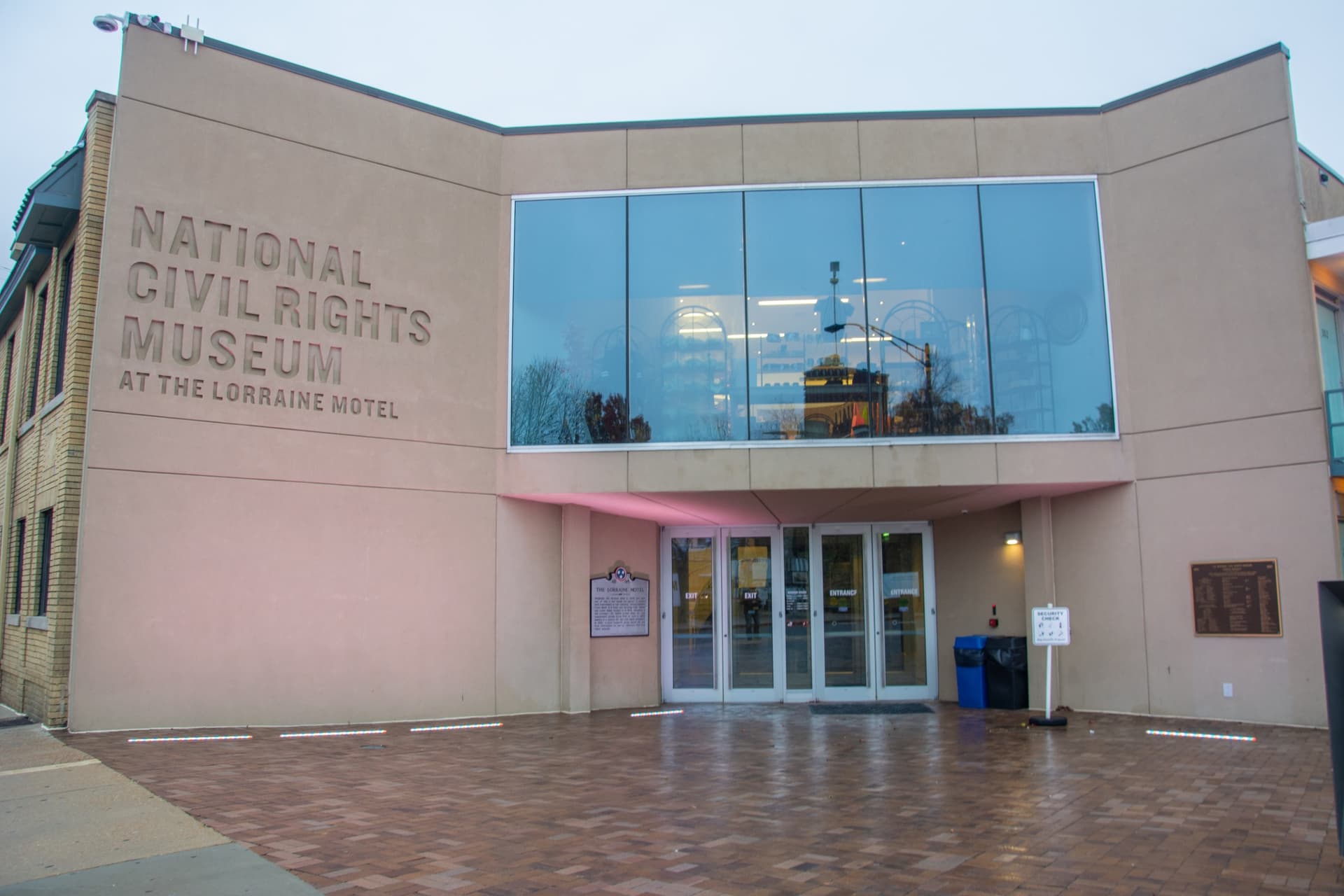
Located at the Lorraine Motel in Memphis, the National Civil Rights Museum traces African American history and the civil rights movement through to the assassination of Martin Luther King Jr.
The National Civil Rights Museum occupies the former Lorraine Motel in Memphis, where Martin Luther King Jr. was assassinated on April 4, 1968. The site chronicles African American history and the civil rights movement in the United States, from the transatlantic slave trade through to contemporary struggles for equality. It is one of five internationally accredited sites of conscience in American territory.
Why visit the National Civil Rights Museum
The museum combines memorial value with a structured educational journey. The building itself is a historical document: Room 306, where Martin Luther King stayed the night before his death, has been preserved as it was and transformed into a commemorative sanctuary as early as June 1968.
The exhibition design draws on immersive reconstructions (bus, lunch counter, courtroom), original artifacts and oral histories from both well-known and lesser-known activists. The narrative extends beyond King alone to reveal a collective movement spanning several centuries. The visit appeals equally to families and travelers interested in the social and political history of the United States.
History of the site
Just weeks after Martin Luther King Jr.'s assassination, Room 306 of the Lorraine Motel is converted into a public memorial. The motel continues its commercial operations under increasingly precarious conditions and defaults on payment in 1982.
The Martin Luther King Memphis Memorial Foundation purchases the building for $240,000 through donations. The site is listed on the National Register of Historic Places, then closes in January 1988 for conversion into a museum. The project is backed by a partnership between the State of Tennessee, Shelby County, and the City of Memphis. The National Civil Rights Museum opens to the public on September 28, 1991.
In 2012, the facility closes for a $27.5 million renovation. It reopens in 2014 with modernized exhibitions, including a replica of the Supreme Court chamber dedicated to the landmark Brown v. Board of Education (1954) decision on school desegregation.
What to see on site
The main exhibition unfolds across two buildings: the former motel and the Legacy building, located across the street, from which the suspected shooter is believed to have fired.
- "Movement to Overcome" sculpture: bronze work by Michael Pavlovsky installed in the atrium, honoring those who fought for equality.
- Culture of Resistance (1619-1861): exploration of the transatlantic slave trade and forms of resistance by enslaved populations, through maps and artifacts.
- Combating Jim Crow (1896-1954): documentation of legal segregation and workaround strategies developed in the American South.
- The Year They Walked: reconstruction of the Montgomery bus boycott (1955-1956) with a restored bus from the era.
- Standing Up By Sitting Down: staging of the 1960 student sit-ins around a lunch counter, with life-size figures.
- Freedom Rides (1961): exhibition centered on the reconstructed shell of the bus burned in Anniston, Alabama.
- I Am a Man — Memphis Sanitation Strike (1968): garbage truck and original picket signs from the sanitation workers' strike that brought Martin Luther King to Memphis.
- Room 306: recreation of Dr. King's final hours, with period furnishings and breakfast tray.
- Legacy building: window from which the shot is believed to have been fired, artifacts related to the investigation, and summary of alternative theories.
The museum also offers forums, lectures, and workshops throughout the year, as well as a rich library of online resources.
Practical information
The museum is open year-round except Tuesdays, with continuous daily hours. Allow 2 to 3 hours to tour the permanent exhibitions at a thoughtful pace. Signage is in English; an audio guide is available and some materials offer translation.
Admission rates fall within the moderate range for American history museums, with reductions for seniors, children ages 5-17, and active military. Entry is free for children under 4. Online booking is recommended, especially around commemorative dates.
The building is accessible to people with reduced mobility (elevators, ramps, wheelchairs available for loan).
When to visit
Attendance increases significantly around Martin Luther King Day (the third Monday in January) and April 4, the anniversary of the assassination. These dates feature special ceremonies and programs, but wait times can be long. For a quieter visit, prefer late autumn or weekday mornings.
How to get there
The museum is located at 450 Mulberry Street, in south-central Memphis (Tennessee). From Beale Street, it's approximately a 10-minute walk south via South 2nd Street then Mulberry Street. Downtown is served by the Memphis Area Transit Authority (MATA) and trolley lines connecting major tourist areas.
Memphis International Airport (MEM) is about 20 minutes by car. The city is also accessible by road via I-40 and I-55, and by Amtrak train from Chicago or New Orleans (City of New Orleans line).
Nearby attractions
Downtown Memphis concentrates several sites that complement your visit:
- Beale Street: historic blues thoroughfare, a 10-minute walk to the north.
- Sun Studio: recording studio where Elvis Presley, Johnny Cash, and B.B. King made their first recordings.
- Stax Museum of American Soul Music: dedicated to Memphis soul and Stax Records label.
- Mississippi River and Tom Lee Park: waterfront promenades along the river.
- Slave Haven Underground Railroad Museum: former safe house on the Underground Railroad, a direct thematic extension of your visit.
Frequently asked questions
Integrating the visit into your trip
The National Civil Rights Museum is a powerful stop on an itinerary through the American South, complementing Montgomery, Selma, and Atlanta on the civil rights route. To plan a customized trip incorporating Memphis and its museums, explore our journeys to the United States.
Interested in this visit?
We can include it in your personalised itinerary.