Rockefeller Center
Rockefeller Center
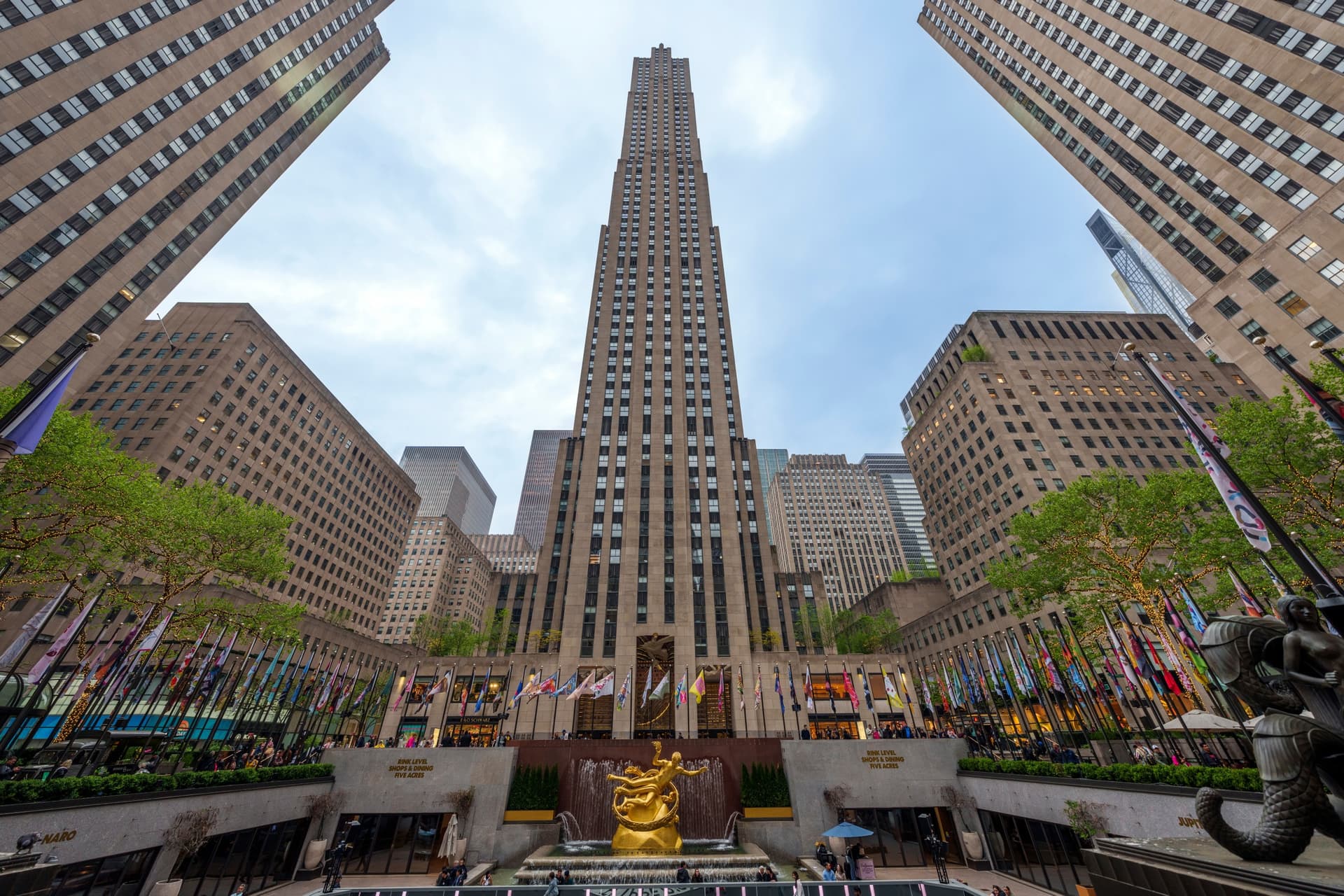
An Art Deco complex in Midtown Manhattan, Rockefeller Center brings together 19 buildings, the Top of the Rock observatory and Radio City Music Hall.
Conceived as a "city within a city" at the heart of Midtown Manhattan, Rockefeller Center encompasses nineteen Art Deco buildings between Fifth and Sixth Avenues. Performance halls, a panoramic observatory, animated plazas and underground galleries form a singular urban ensemble, where the history of the American Great Depression remains readable in the stone.
Why Visit Rockefeller Center
The complex condenses multiple facets of New York into a single location: 1930s architecture, cultural life at Radio City Music Hall, urban panorama from Top of the Rock, and seasonal tradition around the Christmas tree and ice rink. It's also a practical landmark, just a few blocks from Times Square, Saint Patrick's Cathedral and Fifth Avenue's shopping district.
- A coherent Art Deco ensemble designed by Raymond Hood
- One of three major viewpoints over Manhattan
- Continuous animation year-round, particularly vibrant in winter
- A central location with excellent public transit access
History of the Complex
The project is credited to John D. Rockefeller Jr., who envisioned a vast commercial and cultural hub in the early 1930s on land originally designated for a new opera house. The 1929 crash derailed the musical project, but Rockefeller maintained the construction effort. The project provided work for over 40,000 laborers during the Great Depression and symbolized the city's economic resilience at the time.
The initial group of fourteen buildings was completed in 1939. Additional buildings were added subsequently, eventually forming the current complex of nineteen structures. The Art Deco architecture of the complex was designed by Raymond Hood, who also authored other New York buildings in the same style. Limestone facades, sculptural reliefs and vertical lines rhythmically organize the ensemble.
What to See and Do
Rockefeller Plaza
At the foot of the main building stands the gilded statue of Prometheus bringing fire to humanity, one of the most recognizable images of the complex. The plaza transforms with the seasons: a giant Christmas tree and ice rink in winter, terraces, exhibitions and open-air concerts the rest of the year. It's the most photographed spot at Rockefeller Center.
Radio City Music Hall
Opened in 1932, this 6,000-seat venue was originally conceived as an opera house before being converted into a grand performance hall during the Great Depression. Its name comes from the radio stations it housed in its early years. Today, it hosts concerts, musicals, award ceremonies and the famous Radio City Christmas Spectacular, performed annually by the Rockettes during the holiday season. Guided tours of the Art Deco interior are available during the day.
Top of the Rock
The observatory occupies three levels (67th, 69th and 70th floors) of the Comcast Building, approximately 260 meters above street level. The panorama encompasses Central Park to the north, the Empire State Building and southern Manhattan to the south, with the silhouette of One World Trade Center in the background. It's the only vantage point from which you can photograph the Empire State Building within the frame, making it a highly sought-after alternative to the building itself.
Rainbow Room and SixtyFive Bar
On the 65th floor of the Comcast Building, the Rainbow Room has maintained its function since the 1930s as a reception hall and panoramic restaurant. The SixtyFive bar, more accessible, offers cocktails with skyline views. Reservations are required for the restaurant; the bar operates during more limited hours than the observatory.
Underground Galleries
Beneath the complex, a network of pedestrian passages connects the buildings. You'll find shops, cafés and direct access to the subway, allowing you to move around in bad weather without returning to street level. This amenity, innovative at the time of construction, inspired other North American urban centers.
Practical Information
- Address: 45 Rockefeller Plaza, Midtown Manhattan, between 5th and 6th Avenues
- Site access: free and open to the plazas, streets and galleries
- Top of the Rock: paid entry ticket, moderate price, advance reservation recommended for sunset time slots
- Radio City Music Hall: ticket price varies by show; paid guided tours available during the day
- Hours: outdoor spaces are accessible year-round, the observatory and performance hall have their own operating hours, typically from late morning to late evening
- Duration of visit: allow 1 hour for the plaza alone, 2 to 3 hours with Top of the Rock
When to Visit
Seasonality is pronounced. From late November through early January, the illuminated tree and ice rink draw large crowds, particularly on weekends and evenings: plan to arrive early in the morning to enjoy the décor without the crowds. Spring and autumn offer a comfortable balance between pleasant weather and moderate visitor numbers. In summer, terraces and outdoor events animate the plaza, but New York humidity can make waiting outdoors challenging. For Top of the Rock, sunset time slots remain the most sought-after year-round.
How to Get There
By Subway
The 47-50 Streets – Rockefeller Center station, served by the B, D, F and M lines, opens directly into the complex's underground galleries. The 50th Street station, on lines 1, C and E, is a short walk away. The subway remains the simplest and fastest way to get here from anywhere in Manhattan.
By Bus, On Foot or By Car
Several bus lines cross Midtown and pass nearby; check the MTA website for current routes. From Times Square or Saint Patrick's Cathedral, the walk takes less than ten minutes. A car is not recommended: street parking is severely limited and covered parking in the area charges high rates.
Nearby
Rockefeller Center sits within a particularly dense zone of points of interest. Within a few minutes' walk: Saint Patrick's Cathedral, the Museum of Modern Art (MoMA), Times Square, the New York Public Library and Grand Central Terminal. To extend your stay in the États-Unis beyond New York, other urban and natural experiences are worth exploring, such as the Country Music Hall of Fame and Museum in Nashville, Crater Lake National Park in Oregon or the Manoa Falls in Hawaii.
Frequently Asked Questions
Frequently asked questions
No, circulation through the plaza, the complex's streets and underground galleries is free and open to the public. Only the Top of the Rock observatory, guided tours of Radio City Music Hall and performances are paid.
Top of the Rock offers the only panorama that includes the Empire State Building in the view, with Central Park to the north. The Empire State Building is taller and more iconic. Many travelers choose Top of the Rock for the quality of the photographic framing.
Yes, especially for sunset time slots and during the Christmas period. Online reservation with a timed entry avoids long waits on-site.
The tree is traditionally illuminated during a ceremony in early December and remains in place through early January. The ice rink operates from late autumn through spring.
Allow approximately 1 hour if you limit yourself to the plaza and Prometheus statue, and 2 to 3 hours if you add Top of the Rock. A guided tour of Radio City Music Hall adds about 1 hour 15 minutes.
Continue Exploring
Rockefeller Center is just one stop among the many urban and natural experiences a trip across the Atlantic can offer. To plan a complete itinerary, consult our travel ideas for the États-Unis.
Nearby

Interested in this visit?
We can include it in your personalised itinerary.