North Cascades National Park
North Cascades National Park
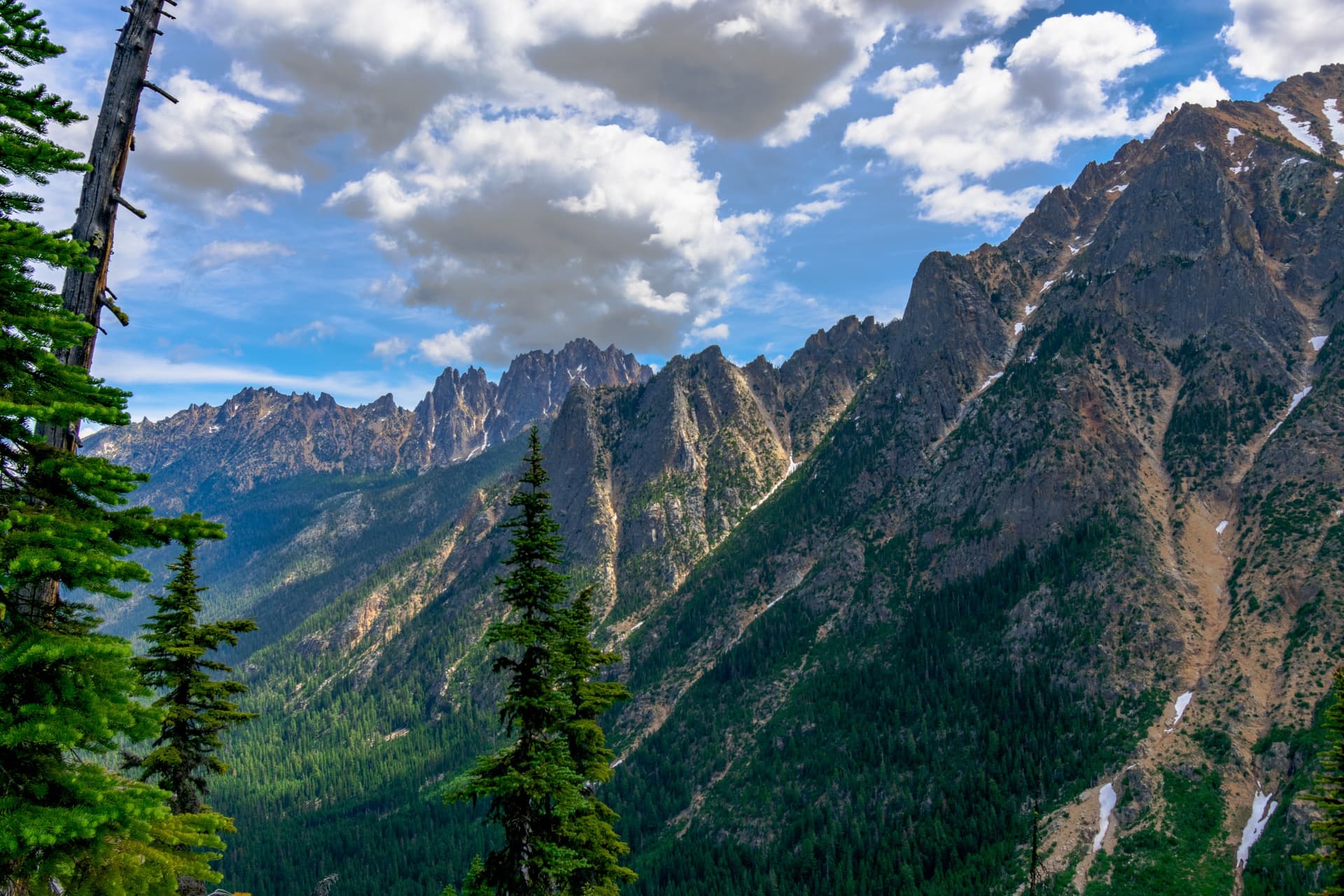
A wild glacial massif in northern Washington State, North Cascades National Park aligns over 300 glaciers, 640 km of trails and turquoise lakes.
The North Cascades National Park protects a wild massif in Washington State, in the northwestern États-Unis. Jagged peaks, glacial valleys and mineral-tinted lakes characterize this park created in 1968, which harbors one of the highest concentrations of glaciers in the 48 contiguous states. Here's what you need to know before heading there.
Why visit the North Cascades
The park ranks among the least visited in the American national network, which contrasts with its immediate proximity to Seattle. For hikers and alpine landscape enthusiasts, it's a more under-the-radar alternative to Yellowstone or Yosemite, without shuttles or queues at viewpoints.
The territory boasts more than 300 glaciers spread across northern slopes, which feed rivers and waterfalls throughout the summer season. This glacial density, exceptional at the temperate latitudes of continental États-Unis, explains the characteristic turquoise color of the park's lakes, laden with fine sediments.
Biodiversity is the site's other major asset. Wildlife includes black bears, mountain goats, cougars, golden eagles and marmots. Vegetation is stratified from dense conifer forests in humid valleys to alpine flower-dotted meadows, passing through alpine tundra zones on the ridges.
History and geology of the park
The North Cascades reliefs formed over 100 million years ago, when the North American plate collided with several terranes of oceanic origin. This tectonic uplift elevated the metamorphic rocks that compose today's sharpest peaks. During the last glaciations, ice tongues carved U-shaped valleys, cirques and knife-edge ridges that define the massif's silhouette.
The territory has been inhabited for millennia by Native American peoples, notably the Skagit on the western slope and the Nlaka'pamux to the north. These communities exploited the valleys as circulation routes and seasonal hunting grounds.
The national park is officially established in 1968, after several decades of advocacy by naturalists and conservation organizations, including David Brower (Sierra Club) and Grant McConnell. The North Cascades Act, signed by President Lyndon B. Johnson, simultaneously establishes the park and the adjacent Ross Lake and Lake Chelan National Recreation Areas.
What to see and do
Emblematic hikes
The park features approximately 640 km of trails, equivalent to 400 miles. A few routes stand out:
- Cascade Pass Trail: the park's signature trail, rated moderate due to elevation gain. It opens onto a panorama of glaciated peaks and forested valleys, with good chances of spotting marmots and mountain goats.
- Maple Pass Loop: 11 km alpine loop located at the park's edge (Okanogan-Wenatchee National Forest). 360° views of lakes and summits; particularly striking in autumn for larch colors.
- Thunder Creek Trail: forest route along a milky river laden with glacial sediments. Gentle elevation gain on the first kilometers, suited for a first-time approach.
- Blue Lake Trail: 7 km round trip to an alpine lake ringed by rocky peaks. Short and accessible trail, located in the adjacent national forest.
- Sahale Arm Trail: demanding extension of Cascade Pass, reserved for experienced hikers. Direct views of Sahale Glacier and high alpine terrain.
Viewpoints accessible by car
- Diablo Lake Overlook: the most photographed vista point, overlooking a lake of mineral green hue due to suspended glacial sediments.
- Washington Pass Overlook: short walk from the parking area, view of Liberty Bell Mountain and the road's switchbacks below.
- Ross Lake Overlook: vista point over the vast reservoir lake, along State Route 20.
Water, camping and mountaineering
Diablo Lake lends itself to kayaking and canoeing, with equipment rental near the dam. Further north, Ross Lake attracts trout fishers (Washington State fishing permit required). For outdoor lodging, the campgrounds at Colonial Creek and along Ross Lake's shores offer a forested setting close to the road, while backcountry bivouacs require a permit. Experienced mountaineers target Mount Shuksan, an emblematic peak of the region.
In summer, rangers offer guided walks and fireside talks, free and mostly without reservation.
How to get there
The park is located approximately two hours' drive north of Seattle and three hours south of Vancouver (British Columbia). The main access is via the North Cascades Highway (State Route 20), which traverses the park from west to east. To the west, it connects to Interstate 5; to the east, it meets US Route 97 and State Route 153 toward the Methow Valley.
No public transport serves the park. A personal or rental vehicle is essential.
When to go
The optimal visiting window spans from mid-June to late September, when snow has melted on the majority of mid-altitude trails. State Route 20 is generally closed from late November to mid-April due to avalanche risk. Autumn, around late September and early October, remains a cherished time for larch colors and low crowds. High-altitude hikes (Sahale Arm, Cascade Pass) often don't open until July.
Nearby
Several sites complement a North Cascades visit:
- Ross Lake National Recreation Area: recreation area embedded within the park, centered on the reservoir lake. Floating cabins accessible only by boat or hiking.
- Lake Chelan National Recreation Area: south of the park, the remote village of Stehekin is accessible only by ferry or seaplane from Chelan.
- Mount Baker: a neighboring glaciated volcano, with its own trails and viewpoints, west of the park.
- Methow Valley: drier valley to the east, known for cross-country skiing in winter and cycle touring in summer.
To extend a trip in the American West, iconic sites like Seattle's Gum Wall or the Golden Gate Bridge in San Francisco offer a contrast to the park's wild atmosphere. Road-trippers heading southwest can also incorporate the Antelope Canyon or Mount Rushmore National Memorial into their itinerary.
Frequently asked questions
Frequently asked questions
Planning your trip
North Cascades National Park naturally integrates into a circuit in the American Northwest, between Seattle, Vancouver Island and the Methow Valley. To build a tailor-made itinerary in the États-Unis, consult our États-Unis journeys.
Interested in this visit?
We can include it in your personalised itinerary.