Mount Rushmore National Memorial
Mount Rushmore National Memorial
Carved into the granite of the Black Hills, Mount Rushmore displays the faces of four American presidents. Complete guide to prepare your visit near Keystone.
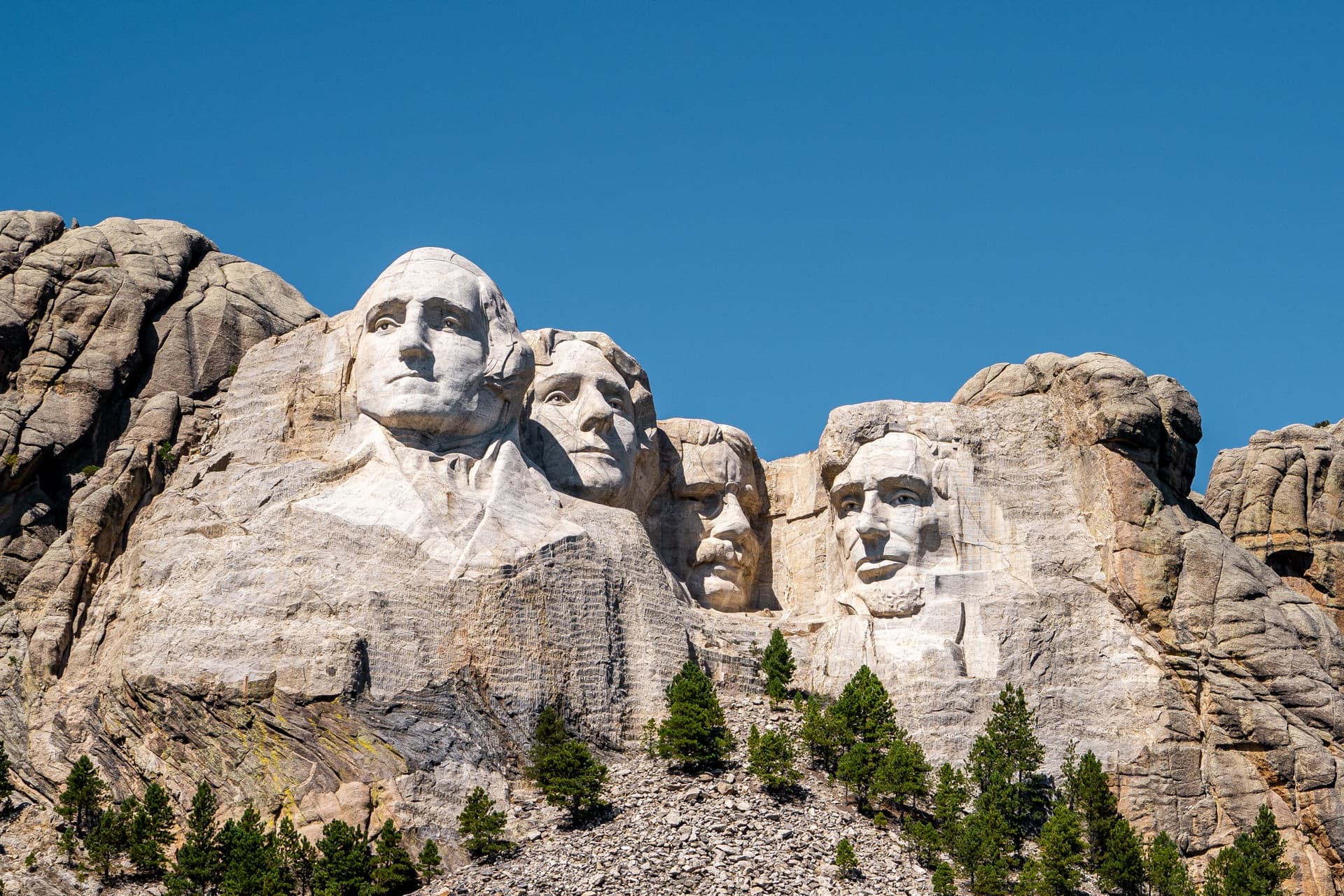
Carved into the granite of the Black Hills in South Dakota, Mount Rushmore National Memorial displays the faces of four American presidents: George Washington, Thomas Jefferson, Theodore Roosevelt, and Abraham Lincoln. Located just a few kilometers from the town of Keystone, this federal monument attracts over two million visitors each year, all coming to witness a monumental work that captures, in stone, a particular interpretation of American history.
Why Visit Mount Rushmore
The memorial covers an area of 5.17 km² and reaches an altitude of 1,745 meters. Beyond the sculpture itself, the site combines several interpretive trails, a museum workshop, forest paths, and an evening lighting ceremony. The visit works equally well as a quick stop or as a half-day of in-depth exploration. The surrounding landscapes, dominated by Ponderosa pines, add a natural dimension to the monument itself.
History of the Monument
In the early 1920s, South Dakota historian Doane Robinson envisioned a monumental sculpture in the Black Hills, initially dedicated to Native American and pioneer figures. Artist Gutzon Borglum, brought in to lead the project, instead proposed representing four American presidents to give the monument national significance. Borglum also wanted to include an archive hall intended to preserve historical artifacts.
After studying rock formations called the "Needles," the designers eventually chose Mount Rushmore for the strength of its granite and its excellent sun exposure—two essential conditions for a sculpture of this magnitude. Work officially began in 1927 and employed nearly 400 workers over fourteen years. The final face was completed in 1939. After Borglum's death in 1941, his son Lincoln Borglum oversaw the completion of the project in October of that same year.
What to See and Do On-Site
Main Viewpoints
The classic route begins with the Avenue of Flags, lined with the banners of the fifty states, leading to the Grand View Terrace. This terrace offers the most well-known frontal perspective of the four faces. For a closer approach, the Presidential Trail descends in a loop to the base of the cliff and allows you to observe the sculpture from different angles, with interpretive panels dedicated to each president.
The Sculptor's Studio
The sculptor's studio, or Sculptor's Studio, houses the original 1/12th scale model as well as the tools used on the construction site. Presentations led by rangers are offered in season as part of the Ranger Walk or Talk program, explaining the extraction and finishing techniques employed between 1927 and 1941.
The Evening Lighting Ceremony
In the evening, the lighting ceremony progressively illuminates the four faces following a brief patriotic presentation. It is one of the highlights of the summer visit. For a tasty treat, Carver's Marketplace offers, among other things, the Thomas Jefferson ice cream ball, a recipe inspired by the one attributed to the president himself.
Wildlife and Flora
The site serves as a refuge for notable biodiversity. Among birds, you can observe turkey vultures, bald eagles, hawks of the Accipiter genus, nuthatches, and woodpeckers. Among mammals are chipmunks, skunks, porcupines, raccoons, beavers, coyotes, bighorn sheep, and more rarely, the bobcat. Vegetation combines Ponderosa pine, oaks, spruces, and poplars, complemented by nine species of shrubs and wildflowers such as snapdragon, sunflower, and violet.
Practical Information
The memorial is managed by the National Park Service and remains open year-round, with extended hours during peak season. Admission to the monument is free, but a paid parking fee is required at the parking entrance. Allow 2 to 3 hours for a comfortable visit, longer if you plan to attend the evening lighting ceremony. The site has a visitor center, cafeteria, and gift shop. The trails have stairs, but the Grand View Terrace is accessible to those with mobility limitations.
When to Visit
The Black Hills climate is humid continental, with approximately 460 mm of annual rainfall. Rain is most abundant in May and June, while summer brings short storms that are sometimes severe. Winters are cold and dry, and snowfall can complicate access. The most comfortable period extends from June to September, with peak crowds in July-August. May and September offer a nice balance between pleasant weather and moderate visitor numbers. The evening lighting ceremony is only offered during warm season.
How to Get There
The memorial is a short distance from the center of Keystone, on routes US-16A and SD-244. From Rapid City, the nearest regional airport, it takes about thirty minutes by car via US-16 and then SD-244. From Custer, to the southwest, allow about thirty minutes as well via US-16/US-385 and SD-244. A car remains the most practical mode of transportation, and several guided excursions depart from Rapid City for those who prefer not to drive.
Nearby Attractions
The Black Hills concentrate several points of interest within short distance, including the Crazy Horse Memorial, Custer State Park, and the Cave of the Winds cave. By expanding your itinerary to the American West, you can combine this stop with other iconic attractions such as Cadillac Ranch in Texas or the landscapes of Canyon Antelope in Arizona. For a more cultural approach, Graceland, the former home of Elvis Presley in Memphis, completes a grand tour of the États-Unis nicely.
Frequently Asked Questions
Frequently asked questions
Incorporating Mount Rushmore Into Your Trip
The memorial is a natural stop on a circuit through the American West, between the national parks of South Dakota, Wyoming, and Montana. To build a custom itinerary that includes the Black Hills and the major sites of the region, consult our États-Unis trip suggestions.
Interested in this visit?
We can include it in your personalised itinerary.