Haleakala National Park
Haleakala National Park
On the island of Maui, Haleakala National Park protects a volcano at 3,055 m, an 11 km crater, and unique endemic biodiversity found nowhere else in Hawaii.
Haleakala National Park protects a dormant volcano reaching 3,055 m that dominates the island of Maui, in the Hawaiian archipelago. The site combines a crater over 11 km in diameter, endemic biodiversity unique to the world, and a night sky conducive to astronomy.
Why visit Haleakala National Park
Haleakala means "temple of the sun" in Hawaiian, referencing the legend of the demigod Maui who is said to have captured the sun atop the volcano to delay the night. This cultural dimension is matched by significant scientific interest: the park is home to species found nowhere else on Earth, beginning with the silversword (haleakala silversword, or ahinahina in Hawaiian), a succulent plant that grows only on the summit and slopes of the volcano.
The park was designated a UNESCO Biosphere Reserve in 1980. The contrast of landscapes, from the subtropical coastline of Kipahulu to the mineral expanses of the summit, makes it a rare vantage point for observation within just a few hours of driving.
History and park status
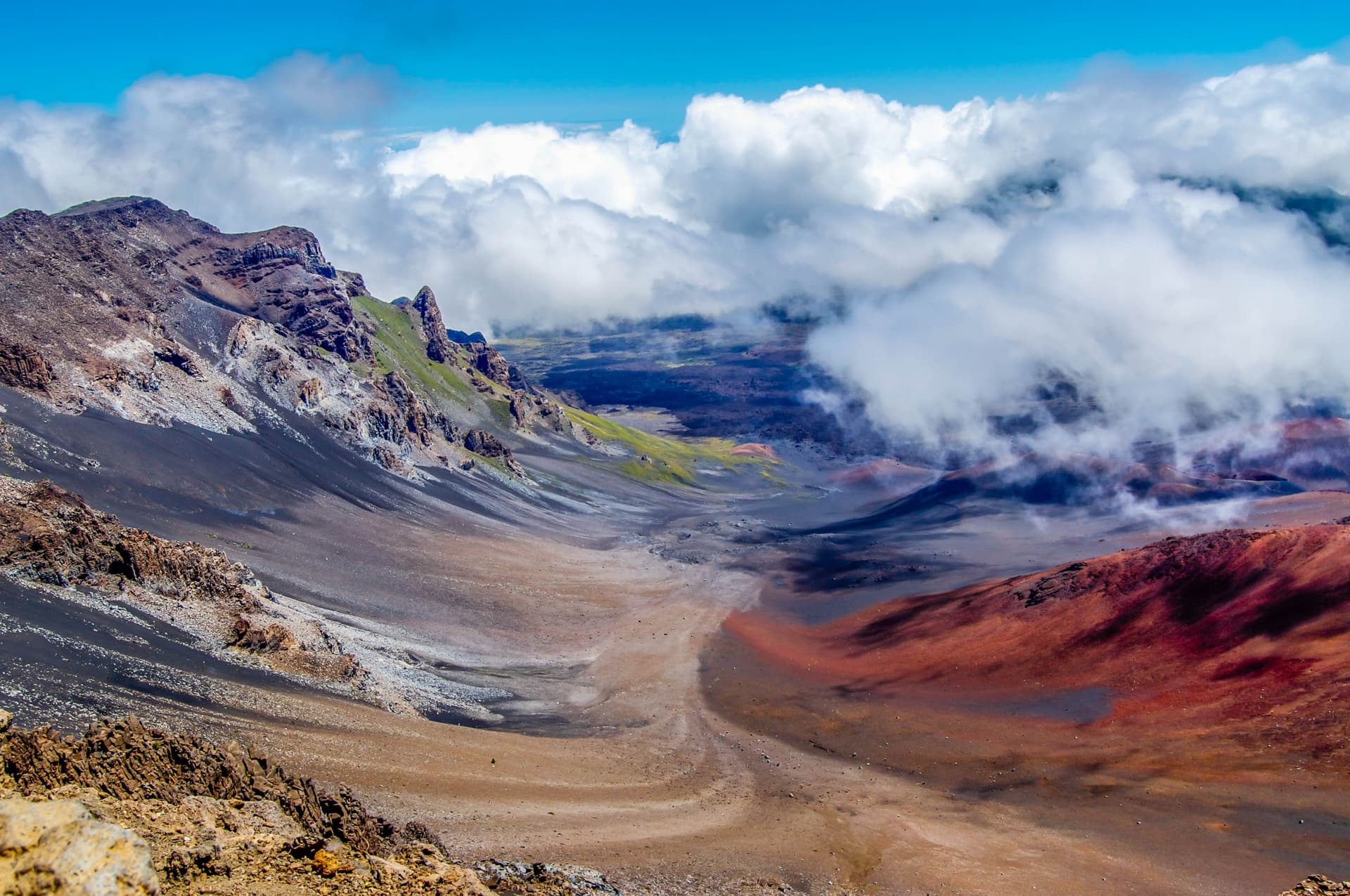
Haleakala volcano experienced its last eruptions between 1400 and 1600. Erosion has since sculpted the lava flows, revealing a spectacular crater dotted with cinder cones and sediments in ochre and red tones.
The site was initially part of Hawaii Volcanoes National Park before being established as a separate national park, officially inaugurated on July 1, 1961. Recognition as a Biosphere Reserve in 1980 confirmed the ecological significance of the location.
Tourism pressure long degraded the habitats: collecting silverswords, once taken as souvenirs, is now prohibited, and travel off marked trails is strictly regulated by rangers.
What to see and do in the park
The crater and hiking trails
The summit crater measures approximately 11.25 km in diameter and 790 m in depth. Two main trails allow descent into it:
- Sliding Sands Trail: direct descent into the caldera from the summit visitor center, through mineral landscape.
- Halemau'u Trail: scenic route with dramatic switchbacks and views of the crater's north walls.
Weather conditions change quickly: bring several layers, a windbreaker, and sturdy hiking boots. The descent is easy; the ascent is considerably more demanding due to altitude.
Viewpoints
- Kalahaku: overlook facing silverswords and interior cones.
- Leleiwi: known for its play of light on the sea of clouds.
- Puʻuʻulaʻula (Red Hill): the park's highest point, equipped with a heated glass shelter, ideal in poor weather or before dawn.
Hosmer's Grove
This experimental forest, planted in the early twentieth century, assembles tree species from around the world acclimated to high altitude: pine, spruce, cypress, Australian eucalyptus, Himalayan cedar. A short loop allows observation of the transition between forest and subalpine heath.
Kipahulu Valley
On the ocean side, Kipahulu district reveals another face of the park: waterfalls, chained natural pools (the Pools of ʻOheʻo), and coastal cliffs. Access is via the Road to Hana and requires a full day.
Endemic fauna
- The nene, an endemic Hawaiian goose and the State bird, is regularly spotted near picnic areas.
- Schiedea haleakalensis, an endemic shrub threatened primarily by introduced wild goats.
- Tardigrades, or "moss piglets" as named by zoologist Ephraim Goeze, measure 0.05 mm at hatching and reach 1.5 mm as adults. They populate moss and lichen cushions on the summit.
Astronomy at the summit
The altitude, dry air, and low light pollution have led to the installation of Haleakala High Altitude Observatory. The summit is highly frequented for sunrise and sunset above the sea of clouds, and for night sky observation.
Practical information
Admission and reservation
Park access is fee-based (moderate per-vehicle charge, reduced rates for pedestrians and bicycles), with a receipt valid for several days covering both districts (Summit and Kipahulu). Prior reservation is mandatory for vehicles wishing to access the summit for sunrise. Check current procedures on the official National Park Service website before departing.
Accommodation
Three camping areas are available: at Kipahulu (coastal side), near the summit, and in the backcountry inside the crater (reservation required). A few rustic wilderness cabins are also available in the crater, by assignment.
Equipment
At the summit, temperatures may drop near freezing before dawn while it is warm in Kahului. Bring a fleece and windbreaker, closed-toe shoes, sunglasses and sunscreen (UV is intense at altitude), water and snacks.
When to visit Haleakala
The park is accessible year-round. The dry season, April through October, offers the most stable conditions for hiking and sky observation. From November to March, showers are more frequent, particularly on the Kipahulu side, but waterfalls are more spectacular then.
For sunrise, plan a very early departure from the coast (1.5 to 2 hours of driving) and dress warmly. Midday clouds often rise to the summit: prefer early morning or late afternoon for panoramic views.
How to reach the park
The park occupies the south-eastern portion of Maui, the second-largest island in the archipelago by area. Two distinct access points:
- Summit District: approximately 2 hours from Kahului, 3 hours from Kaanapali, via Haleakala Highway (routes 37, 377, then 378).
- Kipahulu District: accessible via the Road to Hana, on the south-eastern coast, beyond the village.
No road directly connects the two districts inside the park: you must descend and drive around the volcano. Car rental is essential.
Nearby attractions
Maui lends itself to a multi-destination itinerary. Several sites complement a visit to the park well:
- Iao Valley, west of Kahului, for its verdant walls and the Kuka'emoku pinnacle.
- The Road to Hana, which follows the north-eastern coast: black sand beaches, waterfalls, tropical gardens.
- Crater Lake National Park, another remarkable volcanic site if your trip extends to the mainland.
- The Manoa Falls, on neighboring Oahu island, to extend natural discovery throughout the archipelago.
Frequently asked questions
Frequently asked questions
Yes, the park is open 24/7 year-round, weather permitting. The summit district may be temporarily closed during storms or snow.
Yes. Prior reservation, in addition to the entrance fee, is mandatory to enter the summit between 3 a.m. and 7 a.m. by vehicle. Booking is done online via the park's official website.
Allow a half-day for a simple summit visit with a few viewpoints, a full day to combine hiking in the crater or exploring Kipahulu, and several days for camping inside the crater.
Yes, several short trails (Hosmer's Grove, vehicle-accessible viewpoints, short loop at Pools of ʻOheʻo) suit children. Crater hikes are, however, demanding.
Haleakala means "temple of the sun" in Hawaiian. According to tradition, the demigod Maui captured the sun there to lengthen the days.
Planning your trip
Haleakala National Park naturally integrates into a larger itinerary across the archipelago or the American continent. To build a custom itinerary including Maui and other national parks, explore our trips to the United States.
Interested in this visit?
We can include it in your personalised itinerary.