Alcatraz Island
Alcatraz Island
A former military fortress, federal penitentiary and symbol of the Native American movement, Alcatraz is visited from Pier 33 in San Francisco. History, access and practical advice.
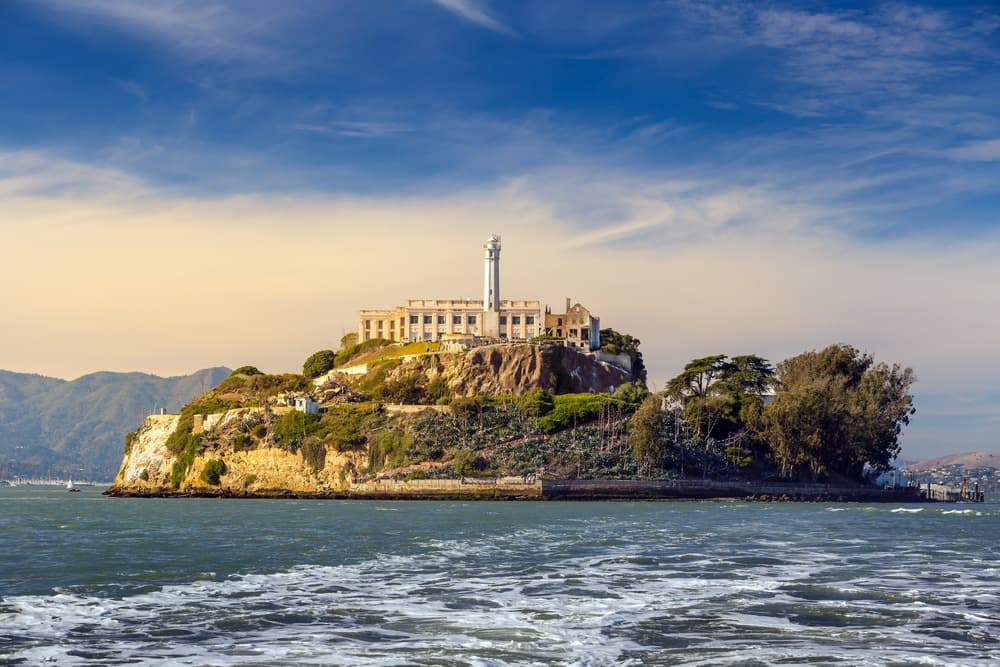
Situated less than 2 km from the Embarcadero in San Francisco, Alcatraz Island concentrates nearly two centuries of American military, penal and political history. A fortress, military prison, then highly secure federal penitentiary, it is today managed by the National Park Service and receives more than one million visitors per year. Its granite silhouette, its buildings weathered by sea spray and its official audio guide make it one of the most striking visits in the bay.
Why visit Alcatraz
Alcatraz is more than just a movie set. The site combines several layers of interest:
- A long chronology, from Ohlone occupation through the closure of the federal prison in 1963.
- An official audio guide built around testimony from former inmates and guards, considered one of the best in its category worldwide.
- A Native American political dimension linked to the 1969-1971 occupation, a foundational moment in the Red Power movement.
- Significant birdlife and open views of the Golden Gate Bridge, the skyline and the bay.
The entire site can be visited in a half-day and naturally complements an exploration of Fisherman's Wharf and the waterfront.
History of Alcatraz
Before colonization: Ohlone presence
Before the arrival of Europeans, the island was part of the territory of the Ohlone tribe, who inhabited the San Francisco Bay region. In 1775, Spanish explorer Juan Manuel de Ayala charts the bay and gives the islet the name Isla de los Alcatraces, referring to the pelicans nesting on its shores — not the gannets, which are absent from the northeastern Pacific. In 1850, following the American-Mexican War, Mexico cedes the island to the États-Unis along with the rest of California.
1859-1866: military fortress
To defend the entrance to the bay during the Gold Rush and later the Civil War, the American military fortifies the island. The fortress could house up to 200 men and was equipped with about a hundred cannons according to military sources of the time. A lighthouse, the first on the west coast of the États-Unis, was put into service as early as 1854.
1868-1933: military prison
As fortifications became obsolete, the island was converted into a military prison. The inmate population grew rapidly: estimated at 441 prisoners in 1903, compared to around twenty a few years earlier. The isolation, glacial waters and strong currents made Alcatraz a secure place of detention. In 1909, the island officially received the status of military penitentiary center.
1933-1963: federal penitentiary
In 1933, management passed to the Department of Justice. Alcatraz became a civilian federal prison intended for inmates deemed most difficult to manage: Al Capone, Robert Stroud known as the "Birdman", Machine Gun Kelly served part of their sentences there. The internal rules were strict: an inmate number replacing the name, a silence rule in cells, privileges (visits, mail, work) to be earned. The families of guards lived on the island, in housing separate from the prison quarters.
Having become too costly to maintain due to salt corrosion, the prison closed in 1963 by federal decision, after 29 years of civilian operation.
1969-1971: Native American occupation
From November 1969 to June 1971, a collective of activists grouped under the name Indians of All Tribes occupied the island for 19 months to demand territorial and cultural rights on behalf of indigenous peoples. This widely publicized occupation is considered a turning point in the Red Power movement and directly influenced federal policy toward Native American nations. Graffiti and inscriptions from that era remain visible on buildings.
What to see and do on site
The cell block and audio guide
The heart of the visit is the Cellhouse, where you walk through the "Broadway" and "Michigan Avenue" corridors, the dining hall, library, exercise yard and the warden's office. The official audio guide, included in the ticket price, features former inmates and guards: it guides visitors cell by cell for approximately 45 minutes. Several cells retain their original furnishings — metal bunk, sink, small shelf — and the reconstructed cell from the 1962 escape attempt (Frank Morris and the Anglin brothers) remains one of the highlights of the tour.
The lighthouse, gardens and wildlife
The current lighthouse, rebuilt in 1909, is generally not accessible to the public inside, but remains visible from the external paths. The former gardens maintained by the families of guards have been restored by volunteers. On the cliffs, you can observe depending on the season cormorants, western gulls, herons, egrets and of course a few brown pelicans.
Temporary exhibitions
The National Park Service and the Golden Gate National Parks Conservancy regularly organize exhibitions on the military, penal or Native American history of the site. Check the schedule when making your reservation.
Practical Information
- Reservation required through the official operator (Alcatraz City Cruises). Tickets sell quickly, especially in high season: plan several weeks in advance.
- Price: moderate to high for a site in the États-Unis, with separate pricing for adults / seniors / children, and a supplement for night visits.
- Duration: allow 2.5 to 3.5 hours on site, including crossings.
- Audio guide included, available in English-speaking format among about a dozen languages.
- Accessibility: electric shuttle available to reach the top of the island from the dock; some areas remain steep.
- Annual closures: New Year's Day, Thanksgiving and Christmas.
- What to bring: windbreaker, closed-toe shoes, water. No food service on the island except on the boat.
When to go
The island is open year-round except for the three holidays listed. High season runs from June to September, with very high demand for tickets and frequent morning fog (the famous Karl the Fog). The months of May, September and October often offer better visibility and more moderate crowds. Night visits, with two later crossings, offer a different atmosphere and access to certain areas not open during the day.
How to get there
Boats from the official operator depart from Pier 33, north of the Embarcadero, about 15-20 minutes' walk from Fisherman's Wharf. The crossing takes approximately 15 minutes. No other dock is authorized to land visitors on the island; be wary of alternative offers that do not provide access to the site.
From downtown, the F-Market streetcar, the Powell-Mason cable car or a walk along the waterfront allow you to reach Pier 33 without a car.
What to see nearby
A visit to Alcatraz fits easily into a day devoted to San Francisco's waterfront:
- Fisherman's Wharf and Pier 39: restaurants, sea lions, views of the bay, a few minutes' walk from Pier 33.
- Golden Gate Bridge: complementary views from Crissy Field or Battery Spencer.
- North Beach neighborhood: Italian heritage and beat generation culture, just behind Telegraph Hill.
To extend a trip to the États-Unis to other striking natural sites, see Bryce Canyon National Park, Canyonlands National Park or the Manoa Falls in Hawaii.
Frequently Asked Questions
Frequently asked questions
Yes. Tickets are sold exclusively by the official operator and often sell out several weeks in advance, particularly in summer and for night visits. Book as soon as your dates are confirmed.
Allow approximately 2.5 to 3.5 hours total: 15 minutes for the outbound crossing, 1.5 to 2 hours on the island (including the audio guide), then the return. Tickets are dated for the outbound journey, but returns are flexible.
Yes, the official Cellhouse audio guide is available in English, along with several other languages. It is included in the ticket price.
A free electric shuttle allows you to avoid the steep climb between the dock and the cell block. However, some outdoor areas and buildings remain difficult to access due to the terrain and uneven ground.
Yes. Several inscriptions and graffiti left by the Indians of All Tribes activists have been preserved on buildings, notably near the water tower and the former barracks. The topic is covered in the audio guide and in interpretation panels.
Preparing your trip
Alcatraz is a striking stop on a San Francisco visit, which combines easily with the California coast, the national parks of the West or a transcontinental itinerary. To plan a tailor-made circuit, consult our travel ideas for the États-Unis.

Interested in this visit?
We can include it in your personalised itinerary.