Hollywood Walk of Fame
Hollywood Walk of Fame
The Walk of Fame in Hollywood lines more than 2,700 stars over 1.6 miles. History, symbols, access and visiting tips in this practical guide.
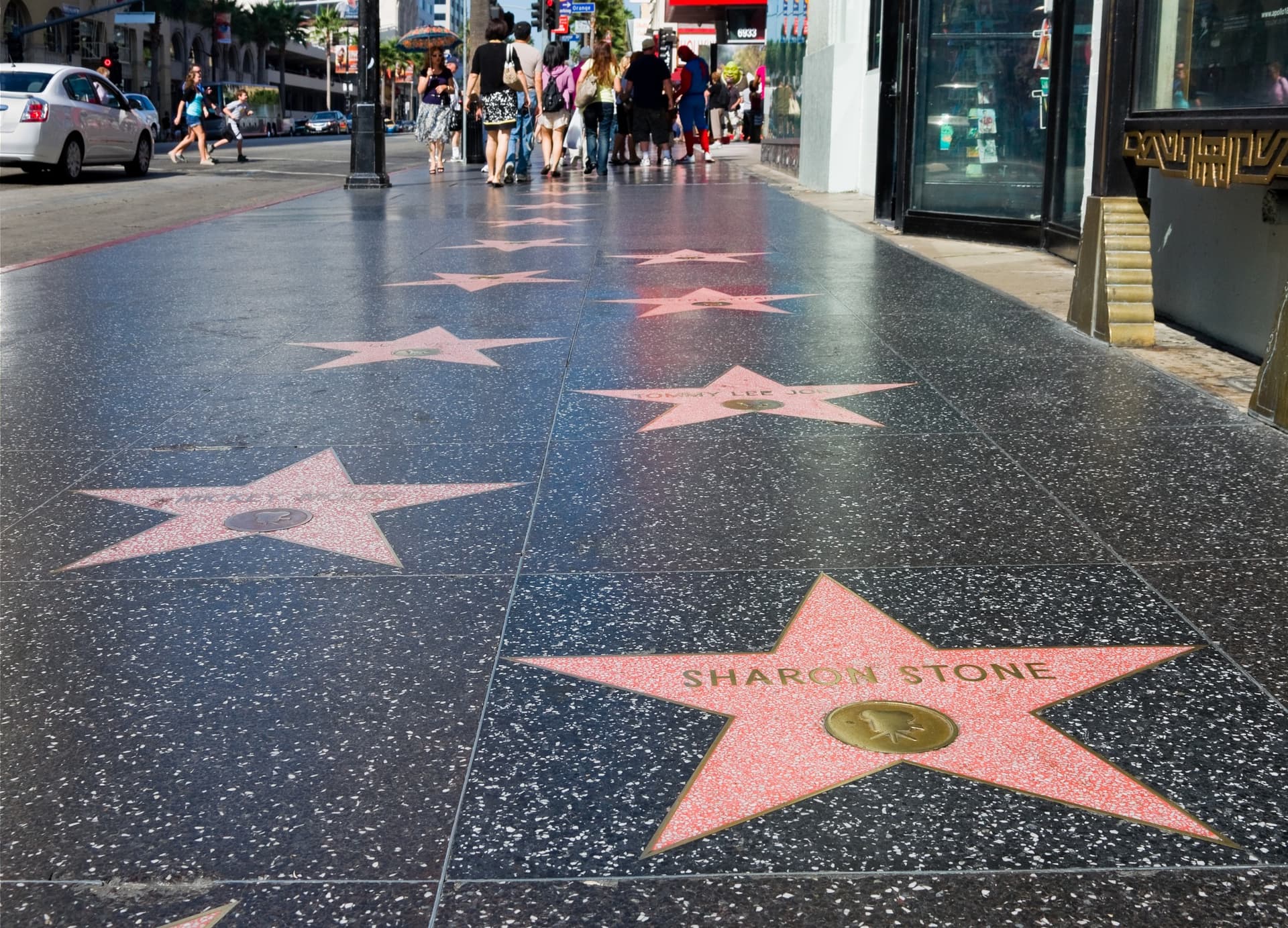
The Walk of Fame is a sidewalk along Hollywood Boulevard and Vine Street in Hollywood (Los Angeles, California). More than 2,700 pink stars with brass borders honor personalities from film, television, radio, music, and theater. The avenue stretches for approximately 1.6 miles, or about one to one and a half hours of walking depending on stops.
Why Visit the Walk of Fame
Beyond its symbolic value, the Walk of Fame offers a free, accessible route through the heart of American cinema culture, open at all hours. Within a few hundred meters, you'll encounter the TCL Chinese Theatre with its handprints, the Dolby Theatre which hosts the Academy Awards ceremony each year, and the Capitol Records Building shaped like a stack of records. The sidewalk itself functions as a non-chronological frieze: a director stands beside a rock group, a silent film actress next to a contemporary streaming star. For travelers interested in pop culture, a stop here is essential on any Los Angeles itinerary.
History of the Walk of Fame
The project was born in 1958 on the initiative of E.M. Stuart, president of the Hollywood Chamber of Commerce. At that time, the neighborhood was losing prestige due to television's rise and the relocation of studios. Stuart proposed a permanent tribute to entertainment figures to restore Hollywood Boulevard's appeal.
The first stars were installed in 1960. The very first star officially inaugurated was that of Joanne Woodward, on February 9, 1960. Among other personalities honored in the first wave were Olive Borden, Ronald Colman, Louise Fazenda, Preston Foster, Burt Lancaster, Edward Sedgwick, and Ernest Torrance. A selection committee has since brought together representatives from film, music, radio, television, and live entertainment. Each new star is unveiled at a public ceremony, most often in the presence of the honoree.
What to See On Site
The Five Categories of Stars
Each star bears a symbol indicating the honoree's field:
- Camera: film
- Television set: television
- Microphone: radio
- Record: music
- Comedy mask: theater and live performance
Some personalities have multiple stars in different categories: Paul McCartney, John Lennon, Ringo Starr, Bob Hope, Mickey Rooney, and Frank Sinatra. Gene Autry is the only one holding five, one in each category.
Atypical Stars
Several stars have been awarded to fictional characters and animals: Lassie (1960), Mickey Mouse, Donald Duck, Winnie the Pooh, The Simpson Family, and Kermit the Frog. Muhammad Ali's star is unique: at his request, it was placed on a wall of the Dolby Theatre rather than on the sidewalk, out of respect for the Prophet's name borne by the boxer.
Buildings to See Along the Route
- TCL Chinese Theatre (formerly Grauman's Chinese Theatre), inaugurated in 1927, famous for its handprints and footprints in the courtyard cement.
- Dolby Theatre, home of the Oscars, accessible by guided tour.
- Hollywood Museum, housed in the former Max Factor building, with over 10,000 objects related to American cinema history.
- Capitol Records Building, a building shaped like a stack of records, symbolizing the golden age of American music.
Practical Information
Access to the Walk of Fame is free and available 24/7. Plan 1 to 2 hours to cover the main section between Gower Street to the east and La Brea Avenue to the west. The cost of installing a new star, funded by the sponsor or studio of the honored celebrity, ranges around $75,000 to $85,000 depending on the year; this amount covers design, installation, and maintenance.
Several French individuals appear on the Walk of Fame: Charles Boyer, Maurice Chevalier, René Clair, Louis Jourdan, and more recently Jean Dujardin. Conversely, George Clooney and Julia Roberts have declined their stars, feeling artistic recognition should be independent of a public monument.
When to Visit
The avenue is visited year-round, with peaks around the Academy Awards ceremony (late February-early March) and during star inaugurations, which draw crowds and media. To enjoy the route without crowds, favor a morning and weekday visit, ideally between 8 a.m. and 10 a.m. The TCL Chinese Theatre area concentrates the activity: costumed street artists, caricaturists, and plan vendors. In the evening, the neighborhood remains active but becomes noisier; better to avoid poorly lit parallel streets.
How to Get There
- By metro: the Red Line (Metro B Line) of the Los Angeles metro directly serves the area with stations at Hollywood/Highland, Hollywood/Vine, and Hollywood/Western.
- By bus: Metro lines 2, 212, 217, and 780 cross Hollywood Boulevard and Vine Street.
- By car: from downtown Los Angeles, take US 101 (Hollywood Blvd or Highland Ave exit). Several paid public parking lots are located around the Dolby Theatre and the former Hollywood & Highland Center (now Ovation Hollywood).
- By bike: the Metro Bike Share network has several stations in the neighborhood, and bike lanes line part of the boulevard.
- On foot: from West Hollywood or Los Feliz, allow 30 to 45 minutes of walking.
What to See Nearby
The Walk of Fame combines easily with other accessible sites on foot:
- TCL Chinese Theatre and its star handprints in cement.
- Dolby Theatre, home of the Oscars, open for guided tours.
- Hollywood Museum, in the former Max Factor building.
- Madame Tussauds Hollywood, wax museum located across from the Chinese Theatre.
- Capitol Records Building, at the corner of Vine Street and Yucca Street.
- Ovation Hollywood (formerly Hollywood & Highland Center), with panoramic terraces overlooking the Hollywood Sign.
- El Capitan Theatre, historic cinema restored by Disney.
To further explore the area, see our Los Angeles guide, which details other neighborhoods to visit.
FAQ About the Walk of Fame
Frequently asked questions
Installation of a star costs in the range of $75,000 to $85,000, funded by the sponsor or studio of the honored celebrity. This amount covers design, installation, and maintenance.
Several French individuals appear on it: Charles Boyer, Jean Dujardin, Maurice Chevalier, René Clair, and Louis Jourdan.
Over 2,700 stars are now embedded in the sidewalk, and several dozen new stars are added each year during official ceremonies.
Among known refusals are George Clooney and Julia Roberts, who declined the honor.
Yes. His star was placed on a wall of the Dolby Theatre rather than on the sidewalk, out of respect for the Prophet Muhammad's name borne by the boxer.
The very first star officially inaugurated was that of Joanne Woodward, on February 9, 1960.
Plan Your Trip
The Walk of Fame fits naturally into a larger California visit. To build a complete itinerary across the country, explore our trips to the États-Unis.
Interested in this visit?
We can include it in your personalised itinerary.