Waimea Canyon State Park
Waimea Canyon State Park
Nicknamed the "Grand Canyon of the Pacific," Waimea Canyon cuts across the island of Kaua'i for 20 km in length and 900 meters in depth. Complete guide for your visit.
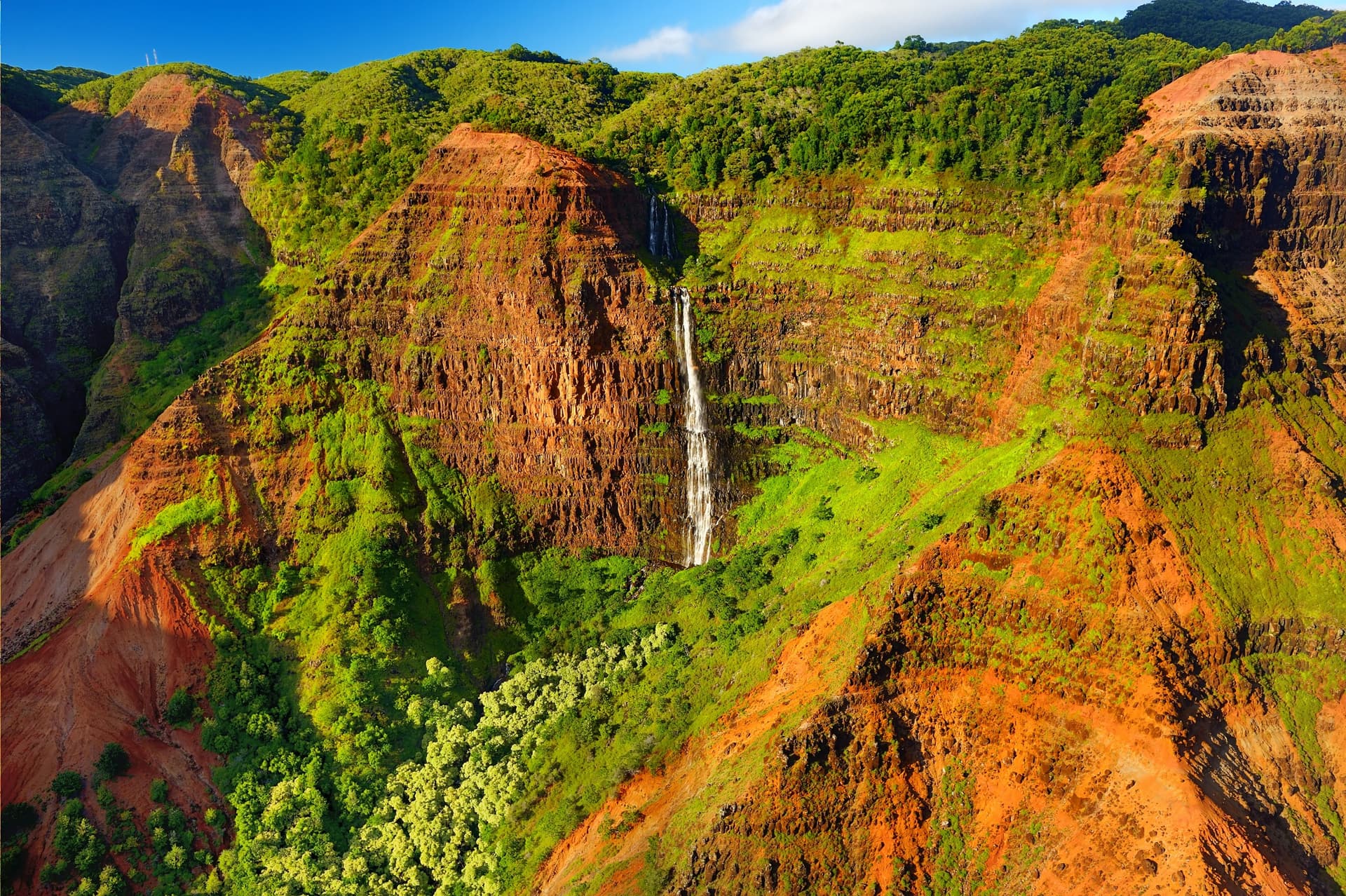
Waimea Canyon State Park protects one of the most distinctive geological formations in the Hawaiian archipelago. Located on the island of Kaua'i, this canyon nicknamed the "Grand Canyon of the Pacific" stretches for more than 20 km in length, 1.5 km in width and descends to 900 meters in depth. Its walls striped with red, ochre and green offer a rare observation ground for understanding Hawaiian volcanic geology.
Why visit Waimea Canyon
The canyon brings together three complementary interests: a spectacular geological landscape shaped by erosion from the Waimea River across volcanic layers, endemic flora and fauna typical of Kaua'i, and a Hawaiian cultural heritage still visible on the ground. Viewpoints are accessible by car along Waimea Canyon Drive, allowing for a visit in a few hours or a two-day exploration when combined with the neighboring Koke'e State Park.
Compared to other natural sites in the archipelago, Waimea Canyon stands out for its changing color palette: hues vary depending on light and humidity, from intense red in mid-morning to softer tones in late afternoon.
History and cultural heritage
Before the arrival of Europeans, the Waimea valley was inhabited by early Hawaiians, who left behind petroglyphs, stone agricultural terraces and ceremonial sites (heiau). These remnants testify to organized occupation, founded on the cultivation of taro irrigated by waters from the Waimea River.
In 1778, Captain James Cook landed at Waimea Bay, at the mouth of the river, and met with local chiefs. This episode marks the first documented contact between Hawaiians and European explorers. The town of Waimea, below the canyon, preserves the memory of this encounter.
From a geological perspective, the canyon results from millions of years of erosion by the Waimea River, which has carved a plateau formed by ancient volcanic flows on Kaua'i. The layers visible on the walls correspond to successive eruptive episodes, oxidized through contact with air and rain.
What to see and do
Main viewpoints
- Waimea Canyon Lookout: the widest perspective over the entire canyon, accessible directly from the road.
- Pu'u Ka Pele Lookout: open view toward Waipo'o Falls and a classic area for photography in morning light.
- Pu'u Hinahina Lookout: dual viewpoint, overlooking the canyon on one side and the island of Ni'ihau in the distance on clear days.
- Kalalau Lookout: situated higher, continuing toward Koke'e, it opens onto Kalalau Valley and the Napali coast.
Hiking to Waipo'o Falls
The trail to Waipo'o Falls is the most-traveled hiking route in the park. Plan approximately 3 hours round-trip for moderate difficulty, with exposed sections. The waterfall drops in two tiers along a canyon wall; the view from the second tier encompasses the river and colorful walls.
Helicopter tour
Several companies based in Lihue offer approximately 1-hour flights covering the canyon, the Napali coast and the interior of Kaua'i. This costly option provides access to perspectives invisible from the road, particularly over interior ridges and waterfalls inaccessible on foot.
Endemic wildlife and flora
The park is home to emblematic species of Kaua'i. Among birds, the nene (Hawaiian goose, protected species) and the i'iwi (small red nectar-feeding bird) are found at different altitudes. Among vegetation, the koa (Hawaiian acacia with prized wood) and the mokihana (fragrant berry endemic to Kaua'i, used in leis) are characteristic of the plateau forests.
Mountain biking and regulated hunting
Certain trails in the area allow for mountain biking, with varying difficulty levels by section. The Koke'e and Pu'u Ka Pele areas are also open to regulated hunting (wild goat, wild boar) according to seasons and permits issued by the State of Hawai'i; inquire in advance with the Department of Land and Natural Resources.
When to visit
Morning offers the best visibility conditions: the sky is generally clear and light highlights the colors of the walls. From early afternoon onward, banks of mist and clouds frequently rise from the canyon floor, especially during the wet season (November to March), and can obscure viewpoints within minutes. Traffic is quieter on weekdays. The climate remains mild year-round, but bring a warm layer: the altitude (around 1,000 m at the highest lookouts) makes mornings chilly.
Practical information
- Fees: moderate entry fee per vehicle, modest surcharge for non-residents. A multi-park pass exists for those planning multiple visits to Kaua'i or Hawai'i state parks.
- Hours: open during daylight, from sunrise to sunset; verify current hours before departure.
- Equipment: hiking shoes, water, windbreaker, sun protection. Mobile network is spotty.
- Rules: stay on marked trails, do not feed wildlife, drones prohibited without authorization, fires and camping limited to designated areas.
How to get there
Lihue Airport, the main gateway to Kaua'i, is approximately 40 km from the park. Car rental remains the most practical option: Waimea Canyon Drive (Route 550) climbs from the town of Waimea to the lookouts in about thirty minutes. Public transportation on the island is limited and does not serve the park interior; it is best to arrange a vehicle to connect the various viewpoints.
Nearby attractions
The park is part of a natural and cultural ensemble worth exploring over several days:
- Koke'e State Park: direct continuation of the canyon to the north, with mountain forest trails and a small natural history museum.
- Napali Coast State Wilderness Park: the wild coast of northwest Kaua'i, accessible on foot (Kalalau trail) or by boat.
- Waimea Town: coastal town at the base of the canyon, home to the historic site of Cook's landing.
For other natural landscapes in Hawai'i, the Manoa Falls on Oahu offer a very different tropical forest atmosphere. On the mainland, Crater Lake National Park presents another spectacular example of volcanic geology.
Frequently asked questions
Frequently asked questions
Half a day is sufficient to drive the scenic route and stop at the main lookouts. Plan a full day if you add the hike to Waipo'o Falls, and two days to combine with Koke'e State Park.
Morning, generally before noon. Mist and clouds often rise in the afternoon and can significantly reduce visibility from the highest lookouts.
It is moderate difficulty, approximately 3 hours round-trip, with exposed and slippery sections in wet conditions. Suitable for regular hikers and children accustomed to hiking.
With difficulty. Kaua'i's public transportation does not serve the park interior. A rental car from Lihue, or an organized tour, remain the most practical options.
It is an expensive activity but reveals areas invisible from the road, particularly the interior of the Napali coast and hidden waterfalls. Worth considering if you stay several days on the island.
Extend your experience
Waimea Canyon naturally integrates into a broader itinerary across Kaua'i and the archipelago. To build a trip combining volcanic landscapes, beaches and Hawaiian culture, consult our suggestions for travel to the United States.
Interested in this visit?
We can include it in your personalised itinerary.