Taos Pueblo
Taos Pueblo
A Native American village continuously inhabited since the Middle Ages in New Mexico, Taos Pueblo is inscribed on UNESCO's World Heritage list for its adobe architecture and cultural continuity.
Inscribed on UNESCO's World Heritage list since 1992, Taos Pueblo stands among North America's oldest continuously inhabited villages. Located in northern New Mexico, approximately 170 km north of Santa Fe and a few kilometers from the town of Taos, this Native American settlement is home to 150 permanent residents within a broader tribal community of 1,900 members. Its adobe structures, occupied without interruption since the Middle Ages, bear witness to a way of life that has endured through Spanish colonization, American conquest, and twentieth-century land dispossession.
Why Visit Taos Pueblo
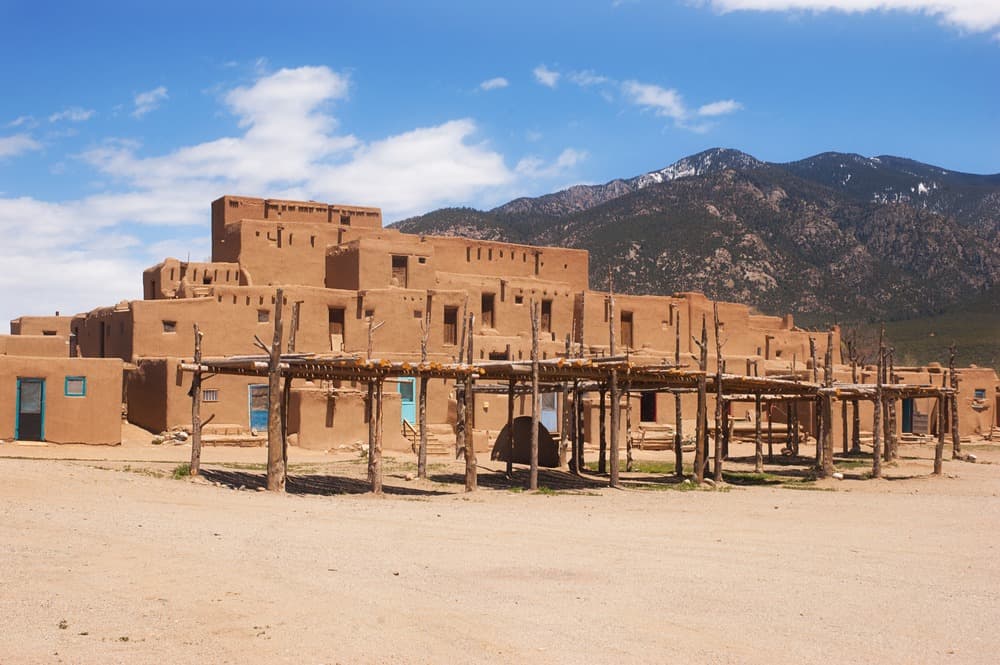
Three elements make this site exceptional. First, unbroken occupation: residents have lived in the same earthen structures for more than five centuries, without electricity or indoor plumbing within the sacred compound. Second, the multi-story adobe architecture, whose northern facade ranks among the continent's most photographed silhouettes. Third, its political and spiritual significance: the 1970 return of Blue Lake and 48,000 acres of ancestral lands remains a rare instance of territorial reparation in United States history.
History of the Pueblo
The village is believed to have been founded between the eleventh and the first half of the fifteenth century, during a migration of Pueblo populations from Rio Grande riverbanks, driven to relocate by a prolonged drought. The site quickly became a trade crossroads between River Basin peoples and their neighbors to the northeast. Each autumn, following harvests, a trade fair brought together neighboring communities and strengthened the pueblo's economic role.
Spanish conquistadors arrived in 1540 with the expedition of Francisco Vásquez de Coronado, launched in search of the legendary Seven Cities of Gold. Around 1620, Franciscan missionaries established the San Geronimo de Taos mission. Coexistence remained strained: in 1660, residents killed the priest and destroyed the church, then participated in the 1680 Pueblo Revolt, a coordinated uprising that temporarily drove the Spanish from New Mexico.
In the early twentieth century, the United States federal government seized 48,000 acres of mountainous lands belonging to the community, including Blue Lake, a sacred site. After decades of advocacy, these lands were restored in 1970 when President Richard Nixon signed Public Law 91-550. The site was inscribed on UNESCO's World Heritage list in 1992.
What to See On Site
Adobe Architecture
Dwellings are built from adobe, a mixture of earth, water, and straw dried in the sun, which effectively insulates against the plateau's hot summers and harsh winters. The main structure on the north side, a multi-story building still inhabited today, represents one of the rarest surviving examples of traditional pueblo architecture.
Originally, houses had no doors or windows: entry was gained through openings in roofs, using wooden ladders that could be withdrawn in case of attack. Roofs rest on Engelmann spruce logs, called vigas, covered with branches, grass, mud, and plaster. Each dwelling typically contains two rooms: one for daily living and sleeping, another for cooking and food storage. Inside the compound, electricity, running water, and plumbing remain prohibited to preserve the site's integrity.
San Geronimo Church and Kivas
The present San Geronimo church, built in 1850, replaces an older chapel destroyed in 1847 during the Taos rebellion against American occupation. While most residents identify as Catholic, ancestral ceremonial practices continue in kivas, partially underground ritual chambers whose access is strictly reserved for community members.
Local Craftsmanship
Several workshops and shops are located within dwellings open to visitors. You will find:
- clay pottery mixed with mica;
- silver and turquoise jewelry;
- leather clothing and moccasins;
- drums and ceremonial objects.
Each piece is signed by the artisan who created it. Outside the homes, hornos, cone-shaped earthen ovens, are still used to bake traditional breads and pastries offered on site according to availability.
Practical Information
The pueblo is explored on foot, following marked pathways. The visitor center issues tickets and provides visiting guidelines. Plan for 1.5 to 2.5 hours on site to tour the village, observe the architecture, interact with artisans, and visit the church. Free guided tours led by community members are regularly offered and provide valuable insight.
A few essential rules:
- photographing residents without their explicit permission is prohibited;
- certain areas (kivas, cemetery, ruins of the old church) are strictly off-limits;
- closures may be announced without notice for religious or community reasons.
Entrance fees are modest and reviewed regularly; consult the pueblo's official website before your visit for current prices and hours.
When to Visit
Peak season runs from late May through early October, with pleasant weather and all public ceremonies (San Geronimo Day in late September, summer Pow-Wows). The pueblo closes to visitors for approximately ten weeks between late winter and early spring, a period dedicated to internal ceremonies; dates vary yearly. Autumn, from September through October, offers a good balance of light, visitor traffic, and community activity.
Getting There
The pueblo sits in a valley drained by a tributary of the Rio Grande, at the base of the Sangre de Cristo mountains. The nearest major airport is Albuquerque, roughly 220 km to the south. From Santa Fe, allow approximately 2 hours by car via US-285 then NM-68, heading up the Rio Grande valley—a scenic drive in its own right.
From downtown Taos, take US-64 northward, then follow signs for "Taos Pueblo" for a few kilometers to the visitor parking area. A personal vehicle remains the most practical option: public transportation is limited in this region.
What to See Nearby
The Taos region lends itself to a multi-day itinerary through the American Southwest. An hour's drive away, the Rio Grande Gorge Bridge spans a spectacular chasm carved into the volcanic plateau. Heading northwest toward Colorado, the Mesa Verde National Park shelters other well-preserved pueblo cliff dwellings. Further west, Antelope Canyon in Arizona completes a remarkable geological loop. To extend exploration of Colorado's landscapes, the Cave of the Winds offers an accessible underground tour.
Frequently Asked Questions
Frequently asked questions
Yes. Approximately 150 people reside there permanently, and the tribal community has nearly 1,900 members. Visitors have access only to public zones.
Plan between 1.5 and 2.5 hours to explore the village, see San Geronimo church, and meet artisans. A free guided tour led by a community member adds approximately one hour.
General photography is permitted, but photographing residents without their authorization is forbidden. Ceremonial areas (kivas, cemetery) are completely off-limits for photography.
No. An annual closure of approximately ten weeks occurs between late winter and early spring for internal ceremonies. Additional sporadic closures may also occur without notice.
The community has chosen to prohibit electricity, running water, and plumbing within the historic compound to preserve the site's integrity and maintain continuity of traditional lifeways.
Plan Your Trip
To incorporate Taos Pueblo into a complete itinerary exploring the landscapes, Native American sites, and national parks of the Southwest, consult our United States travel packages.
Interested in this visit?
We can include it in your personalised itinerary.