Yellowstone National Park
Yellowstone National Park
The world's first national park, Yellowstone brings together half of the planet's geysers, iconic wildlife, and volcanic landscapes across 9,000 km².
Straddling three States — Wyoming, Montana, and Idaho — Yellowstone National Park covers nearly 9,000 km² of high volcanic plateaus, forests, and valleys. It is here, perched atop an active caldera, that approximately half of the world's geysers are concentrated, alongside some of North America's most visible wildlife.
Why visit Yellowstone
Yellowstone brings together three rare experiences in a single territory. Geothermal activity first, with geysers, hot springs, and mud basins that constantly remind visitors the park rests on an active magma chamber. Wildlife second: bison, elk (wapiti), grizzly bears, black bears, wolves, and coyotes roam freely, and several valleys such as Lamar and Hayden offer viewing opportunities that have become rare elsewhere on the continent. And landscapes finally, from the Grand Canyon of the Yellowstone to the shores of Yellowstone Lake, which structure a varied itinerary across several days.
A pioneering history
Yellowstone is the world's first national park. It was established on March 1, 1872, by an act signed by President Ulysses S. Grant, laying the groundwork for the national park model that would later spread internationally. Before this federal protection, the region had long been visited by several Native American peoples, including the Shoshone, Bannock, Crow, and Nez Percé, who used its geothermal resources and hunting routes.
In 1978, UNESCO inscribed Yellowstone on the World Heritage List, in recognition of its geological and ecological value. The park is today managed by the National Park Service.
Sites to see
Old Faithful and the Upper Geyser Basin
Old Faithful owes its name to the relative regularity of its eruptions, which shoot a column of boiling water dozens of meters into the air. The intervals between eruptions are posted at the nearby visitor center. The surrounding basin concentrates a remarkable density of geysers and smaller hot springs, accessible via a network of wooden boardwalks.
Grand Prismatic Spring
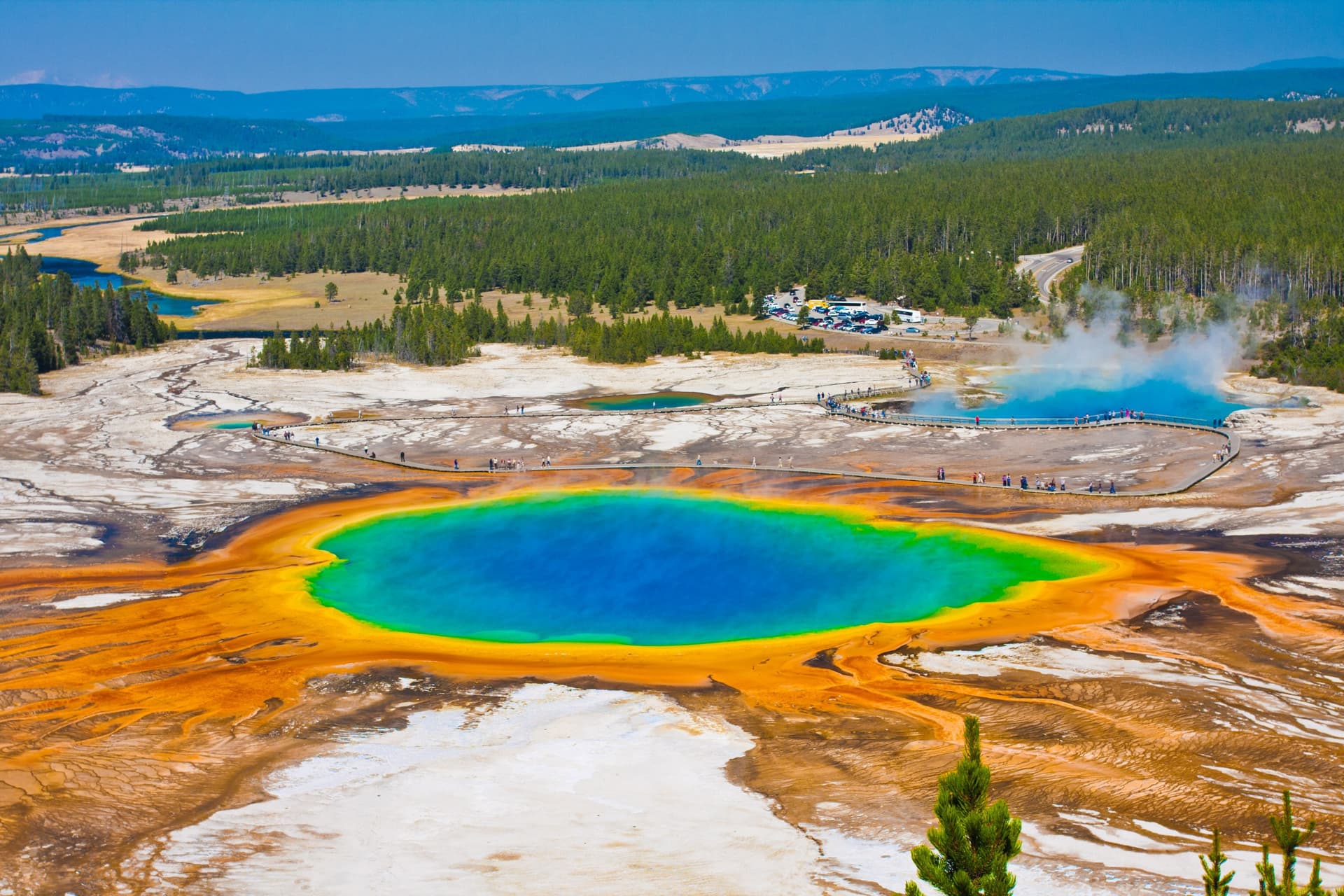
North America's largest hot spring, Grand Prismatic Spring owes its rings of color to thermophilic bacteria and archaea that thrive at different temperatures. To fully grasp the color gradient, the overlook on the Fairy Falls Trail offers an elevated view, complementing the perspective from the boardwalks at basin level.
Mammoth Hot Springs
In the north of the park, Mammoth Hot Springs features a collection of travertine terraces formed by calcium carbonate deposits. These hot springs are constantly evolving: some terraces dry out while others reactivate, altering the site's appearance from season to season.
Grand Canyon of the Yellowstone and Canyon Village
The Yellowstone River has carved a canyon roughly thirty kilometers long, punctuated by the Upper Falls and Lower Falls (the latter measuring nearly 94 meters). Canyon Village, located on the edge, serves as a practical base for reaching the viewpoints at Artist Point and Lookout Point. Yellowstone Lake, to the south, is one of the continent's largest high-altitude lakes.
Lamar and Hayden Valleys
These two valleys are the finest areas for observing wildlife, particularly at sunrise and sunset. Bison herds are frequent here, and Lamar Valley is renowned for its wolves, which were reintroduced in the 1990s.
When to visit
The park is open year-round, but accessibility varies considerably.
- Summer (June to August): pleasant days, around 15°C on average with nights near 3°C, all roads open. This is peak season, with accommodations to be booked several months in advance.
- Autumn (September-October): fewer crowds, wildlife very active before winter, but first snow possible as early as October.
- Winter (December to February): harsh temperatures (around -5°C by day, down to -18°C at night), most roads closed to vehicles. Access is by guided snowcoach, snowmobile, or cross-country skiing from the Mammoth and West Yellowstone entrances.
- Spring (April-May): gradual reopening of roads, birth of young bison and elk calves.
Practical information
- Allow a minimum of 3 days to cover the main sites, ideally 5 to 7 days to include wildlife viewing and some hiking.
- The park charges an entrance fee per vehicle, valid for 7 days; the annual inter-park pass (America the Beautiful) is worthwhile if visiting two or more parks.
- Stay at least 100 meters away from bears and wolves, and 25 meters from bison and other ungulates. Bison attacks on visitors standing too close occur regularly.
- Never leave the boardwalks in thermal areas: the crust is thin and water can exceed 90°C.
- Mobile network coverage is very limited; download your offline maps before arrival.
How to get there
Three regional airports provide reasonable access to the park: Bozeman (Montana) to the north, Jackson Hole (Wyoming) to the south, and Cody (Wyoming) to the east. Bozeman is the most served and most convenient for combining Yellowstone and Grand Teton. Once there, a rental car is almost essential, as the shuttle network is limited.
The park has five main entrances: West Yellowstone (the busiest), Gardiner to the north (the only entrance open to vehicles year-round), Cooke City to the northeast, the East Entrance via Cody, and the South Entrance from Jackson and Grand Teton.
Nearby
Yellowstone lends itself well to a combined itinerary with other major sites in the American West:
- Grand Teton National Park, just to the south, naturally extends the visit with its granite peaks and glacial lakes.
- Further east, the Mount Rushmore National Memorial in South Dakota makes a notable historical stop.
- For grand canyons and deserts, Antelope Canyon and Mesa Verde National Park allow you to expand a road trip toward the Southwest.
- To stay within the realm of wild parks in the northwest, the North Cascades National Park in Washington State offers another perspective on the Rocky Mountains and Cascade Range.
Frequently asked questions
Frequently asked questions
Three days allow you to see Old Faithful, Grand Prismatic, Mammoth Hot Springs, and the Grand Canyon of the Yellowstone. To also enjoy wildlife viewing in Lamar and Hayden Valleys and do some hiking, allow 5 to 7 days.
West Yellowstone is the most central entrance for reaching the geysers. Gardiner, to the north, is the only entrance open to vehicles year-round. The choice largely depends on your arrival airport and planned itinerary.
Bison are frequent throughout the season, particularly in Lamar and Hayden Valleys. Bears (black and grizzly) are best observed in spring and early summer, early morning or late afternoon. Binoculars are very helpful.
The park is safe if you follow the guidelines: stay on boardwalks in thermal areas, maintain distance from wildlife, carry bear spray while hiking, and never feed the animals.
Yes, but most roads are closed to regular vehicles from November to April. Access is then by snowcoach, guided snowmobile, or cross-country skiing from the Mammoth and West Yellowstone entrances.
Plan your trip
Yellowstone is rarely experienced alone: it almost always integrates into a broader itinerary across the American West. To build a custom journey including the Rockies, major parks, and legendary cities, explore our trips to the États-Unis.
Interested in this visit?
We can include it in your personalised itinerary.