Wind Cave National Park
Wind Cave National Park
In the Black Hills of South Dakota, Wind Cave protects one of the world's rarest underground networks, featuring distinctive limestone boxworks, and an original prairie home to bison and elk.
Wind Cave National Park protects one of the world's longest underground networks and one of the last remaining native prairies of the Great Plains. Located in the Black Hills, in the south of South Dakota, it combines a limestone universe with rare geological formations, the boxworks, and a surface ecosystem where bison, elk, and prairie dogs thrive.
Why visit Wind Cave
The park draws fewer visitors than its neighbors Mount Rushmore or Custer State Park, yet it offers a rare combination in the États-Unis: an accessible underground network with guided tours and, just above ground, a preserved mixed prairie roamed by the great fauna of the plains. It's also one of the few places in the world where you can observe boxworks, delicate limestone blades arranged in honeycomb patterns that line certain passages.
The experience remains understated: no spectacle, minimal infrastructure, quiet trails. For those seeking a complete nature experience in the Black Hills, Wind Cave is a credible alternative to the region's more tourist-heavy sites.
History and cultural significance
For the Lakotas, the cave is far more than a geological site. It is Maka Oniye, the sacred place from which their people emerged at the dawn of time, and a passage between the underworld and the surface. This spiritual dimension remains alive today, and the park service acknowledges it in its interpretation.
The cave was rediscovered in 1881 by brothers Tom and Jesse Bingham, intrigued by a stream of air escaping from a small opening in the rock. This phenomenon is explained by the pressure difference between the interior and exterior: when atmospheric pressure drops, air is expelled; when it rises, air is drawn in. This breath gave the site its name.
In 1903, President Theodore Roosevelt proclaimed Wind Cave a national park. It became the first park in the États-Unis created specifically to protect a cave, and one of the earliest national parks in the country.
What to see and do
The cave and guided tours
The surveyed network now extends beyond 240 km of passages, placing Wind Cave among the world's longest caves. Access is only by guided tour, led by rangers, with limited places available.
The Natural Entrance, the small opening where you can still perceive the air movement, is the cave's historic and spiritual entrance. It's no longer used for tours but remains visible near the visitor center.
- Garden of Eden Tour: a short, physically easy tour ideal for first-time visitors, showcasing different types of mineral formations.
- Fairgrounds Tour: a more comprehensive route through vast chambers and numerous passages lined with boxworks. Expect several hundred steps: this circuit requires good physical fitness.
Other circuits, including lantern tours or caving outings, are sometimes offered depending on the season. Check at the visitor center when you arrive.
Prairies, wildlife, and trails
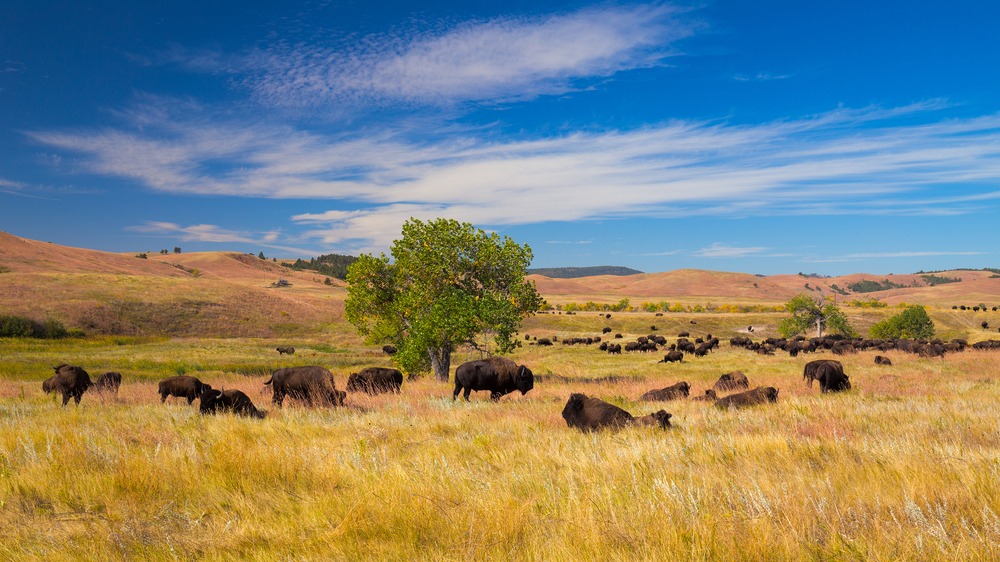
Above ground, the park protects one of the best-preserved mixed prairies of the Great Plains. You'll regularly spot bison, elk, pronghorns (American antelopes), prairie dogs in their characteristic colonies, coyotes, and deer. Golden eagles occasionally soar above the ridges.
Explore the park on foot, by bicycle on open roads, and partly on horseback on authorized trails. The paths wind through ponderosa pine forests, rolling hills, and small canyons.
Rankin Ridge
The short Rankin Ridge loop leads to an old fire lookout tower that marks the highest point in the park. The trail traverses a pine forest and offers expansive views of the Black Hills and surrounding prairies. It's one of the best spots for sunset.
Camping
The Elk Mountain campground, near the visitor center, is open year-round. Services are limited off-season. Sites accommodate both tents and vehicles. Staying overnight lets you take advantage of very little light pollution and observe wildlife at dawn.
Practical information
Park entry is free, unlike many other American national parks. Guided cave tours, however, are paid (moderate rates) and can be booked at the visitor center or online. In high season, it's best to arrive early in the day or book in advance.
Plan for half a day to combine a cave tour and a surface trail, a full day if you add Rankin Ridge and wildlife watching time. The cave temperature remains cool year-round: bring a light jacket and sturdy closed-toe shoes.
When to visit
Spring and autumn offer the most pleasant hiking conditions, with moderate temperatures and active wildlife. Summer is peak season: hot days, busy guided tours, advance booking recommended. Winter is quiet and cold; some tours are suspended, but the atmosphere of snow-covered prairies is worth the visit if you're properly equipped.
How to get there
The nearest airport is Rapid City Regional Airport, about an hour's drive to the north. Wind Cave is accessible by car via US 385 and SD 87, which run through the park. Parking is available at the visitor center and near main trailheads. The closest towns for lodging and dining are Hot Springs (to the south), Custer (to the northwest), and Rapid City (further north).
In the surrounding area
The Black Hills concentrate several major sites within an hour of Wind Cave:
- Mount Rushmore National Memorial, the monumental sculpture of four presidents.
- Custer State Park, roughly 280 km² of hills and prairies roamed by a large bison herd.
- Jewel Cave National Monument, home to the world's third-longest cave, complementary to Wind Cave for its mineralogy.
- Crazy Horse Memorial, a monumental sculpture still under construction, dedicated to Chief Crazy Horse.
To extend your underground experience elsewhere in the États-Unis, you can compare with Cave of the Winds in Colorado, or with another major volcanic park like Crater Lake National Park.
Frequently asked questions
Frequently asked questions
Planning your trip
Wind Cave fits naturally into an itinerary through the Black Hills, between Mount Rushmore, Custer State Park, and the Badlands. To build a coherent route incorporating this stop, consult our ideas for travel to the États-Unis.
Interested in this visit?
We can include it in your personalised itinerary.