Everglades National Park
Everglades National Park
1.5 million hectares of marshes and mangroves in southern Florida: unique wildlife, alligators, migratory birds and three entrance gates to explore this UNESCO-listed park.
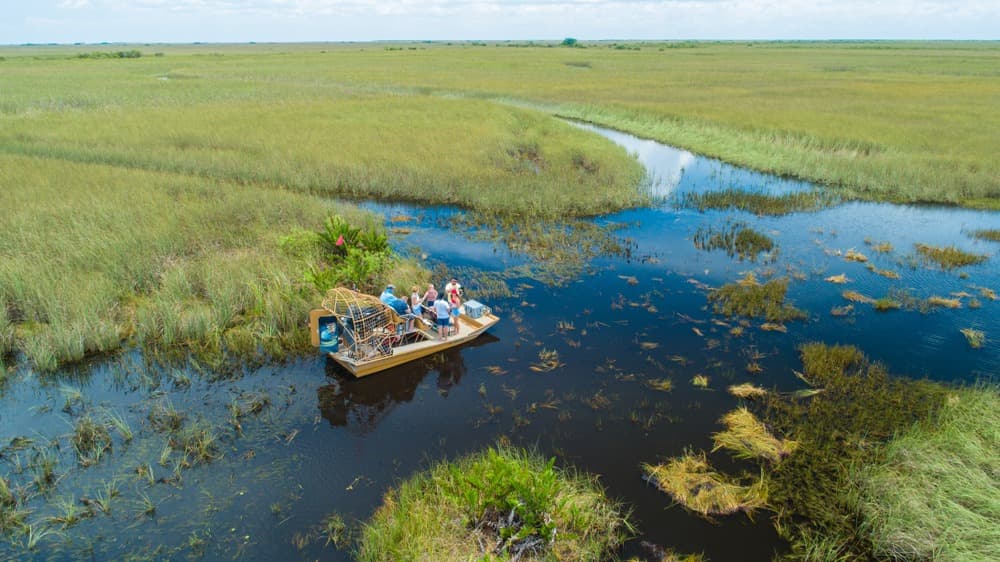
At the southern tip of Florida, Everglades National Park protects nearly 1.5 million hectares of mangroves, freshwater marshes and salt lagoons. This vast subtropical ecosystem, designated a UNESCO World Heritage Site and biosphere reserve, is home to alligators, crocodiles, manatees and over 350 bird species. Three main entrances provide access to the park: the main entrance near Homestead, Shark Valley to the north from Miami, and the Gulf Coast Visitor Center to the west from Naples.
Why visit the Everglades
The Everglades constitute one of the rare ecosystems in the world where fresh and salt waters meet over such a vast area. The park spans across Collier, Miami-Dade and Monroe counties, and concentrates a biodiversity that few North American sites can claim.
Over 2,000 plant species have been recorded here, from bald cypress to red mangroves, along with hundreds of orchids and bromeliads. As for wildlife, the Everglades are the only place on Earth where alligators and crocodiles coexist in the wild. The diversity of migratory and nesting birds makes it a major site for birdwatching in North America.
History and protection status
Everglades National Park was officially established in 1947, largely due to journalist Marjory Stoneman Douglas, whose book The Everglades: River of Grass had alerted the public to the fragility of this "river of grass." Unlike most American parks founded for their spectacular landscapes, the Everglades were created to preserve an ecosystem threatened by agricultural drainage and urbanization in South Florida.
UNESCO inscribed the park as a World Heritage Site in 1979 and later designated it a biosphere reserve. Today, large-scale hydrological restoration programs are working to restore natural water flows altered by a century of development.
What to see and do
Observe wildlife
Alligators are visible year-round along trails and canals, particularly on the Anhinga Trail near the main entrance. Crocodiles, more elusive, frequent the brackish waters of the park's southern reaches, around Flamingo. Mammals present include the Florida panther (very shy), black bears, manatees and dolphins in coastal waters.
With binoculars, birdwatchers can spot roseate spoonbills, snowy egrets and wood storks, an endangered wading bird endemic to North America.
Hike or cycle
Short boardwalk trails allow you to traverse different habitats without special equipment. The Shark Valley Tram Road, a 24 km loop, can be explored by bike or narrated tramway. Bicycles are available for rent at the Shark Valley visitor center and at Flamingo Marina.
Kayak or boat exploration
The park has extensive waterways, including the renowned Wilderness Waterway linking Flamingo to Everglades City over nearly 160 km. Boat tours depart from Flamingo and Gulf Coast into the mangrove and Ten Thousand Islands. Sport fishing enthusiasts pursue sea trout, snapper and tarpon.
Camp on site
Two main road-accessible campgrounds are available: Flamingo, at the end of the main road, and Long Pine Key, about 11 km from the visitor center. Backcountry camping sites along waterways allow for a more immersive experience, by reservation.
When to visit
The dry season, from December to April, remains most favorable: comfortable temperatures, low humidity and wildlife concentrated around water sources. April and October offer a good balance between crowds and weather conditions. Spring is particularly interesting for witnessing bird courtship displays and breeding plumage.
Summer is best avoided: scorching heat, heavy rainfall, abundant mosquitoes and hurricane risk from June to November. Whatever the season, animals are most active at dawn and dusk.
Practical information
- Duration of visit: plan at least one day for one entrance, two to three days to explore multiple areas.
- Admission: per-vehicle fee, valid for 7 days; the America the Beautiful Pass is accepted.
- Gear: water, sunscreen, closed-toe shoes, strong insect repellent, binoculars.
- Accommodation: campgrounds in the park, wide choice of hotels in Homestead, Florida City, Miami and Naples.
How to get there
A car is essential, as the park is not served by public transportation. Three distinct access points, not connected to each other within the park:
- Main entrance (Ernest F. Coe Visitor Center): about 16 km southwest of Homestead, or 1 hour's drive from Miami. This is the gateway to Royal Palm, Long Pine Key and Flamingo.
- Shark Valley: on US-41 (Tamiami Trail), about 45 minutes west of Miami.
- Gulf Coast Visitor Center: in Everglades City, accessible from Naples in less than an hour.
Nearby attractions
After the Everglades, several extensions are possible throughout Florida and beyond. For those wishing to explore other American national parks with contrasting landscapes, Bryce Canyon National Park in Utah offers a striking contrast with its hoodoo amphitheaters. For dramatic natural scenery, Manoa Falls in Hawaii extends your immersion in a tropical setting.
Frequently asked questions
Frequently asked questions
Want to include the Everglades in a larger itinerary? Explore our custom United States travel ideas, combining nature, iconic parks and legendary cities.
Interested in this visit?
We can include it in your personalised itinerary.