Arches National Park
Arches National Park
Near Moab, in Utah, Arches National Park concentrates over 2,000 sandstone arches, pinnacles and balanced rocks across 310 km².
Arches National Park, in eastern Utah, brings together over 2,000 sandstone arches across approximately 310 km² of the Colorado Plateau. Located 7 km north of Moab, it holds the highest concentration of natural arches in the world, along with pinnacles, monoliths and balanced rocks that compose an iconic landscape of the American Southwest.
Why visit Arches National Park
The park gathers in one location an entire repertoire of forms sculpted from red sandstone: massive or delicate arches, towers, fins, petrified dunes. The distances between major points of interest remain short, making it possible to explore a substantial part of the park in a single day from Moab, or to linger longer to capture the spectacular light at sunrise and sunset on the stone.
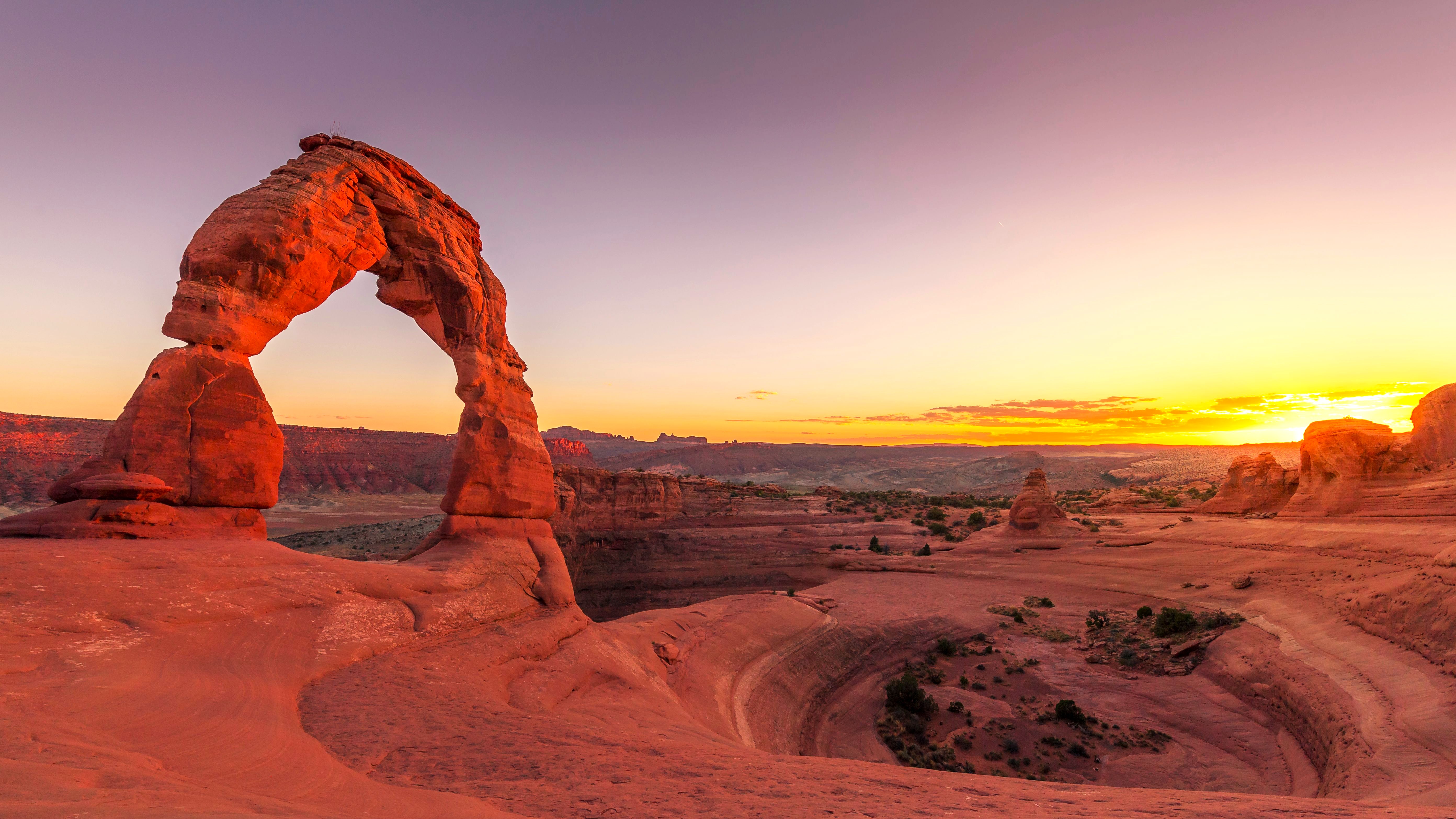
The silhouette of Delicate Arch has become one of Utah's visual symbols, reproduced on the state's license plates, and several sites within the park — Double Arch foremost among them — have served as backdrops for Hollywood films.
History and geology
The sandstones forming the arches belong to the Entrada and Navajo formations, deposited during the Jurassic period. Through the combined effects of salt layer movements deep underground, dissolution by water, and erosion from frost and wind, these sandstones fractured into long parallel ridges (called fins, then were gradually pierced to create the arches we see today. The process unfolds over millions of years and continues today: some arches collapse while others emerge.
The region was inhabited approximately 10,000 years ago by ancestral Pueblos, then crossed in the 18th century by Spanish expeditions, including that of Domínguez and Escalante in 1776. The site was declared a national monument in 1929 by decree of President Herbert Hoover, before being elevated to national park status in 1971. Publication of Desert Solitaire by former ranger Edward Abbey helped draw the general public to the area in the 1970s.
What to see in the park
Park Avenue and Courthouse Towers
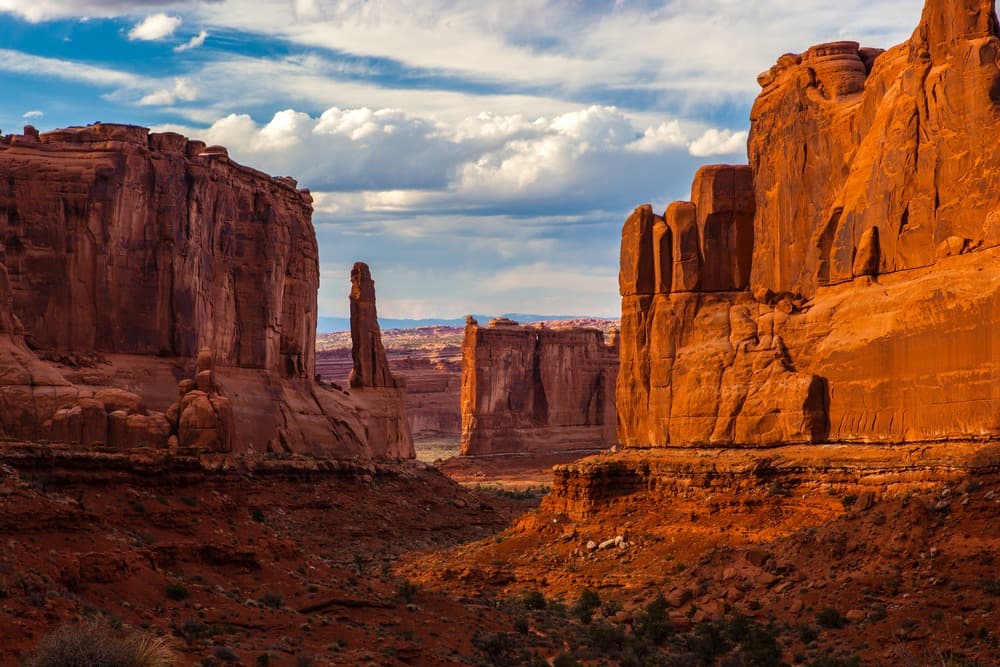
The first stop after the entrance, Park Avenue is a sunken valley bordered by vertical walls. The short trail following its floor leads to the Courthouse Towers and passes near the Three Gossips, three slender pinnacles visible from the road as well.
Balanced Rock
Less than 15 km from the entrance, along the main road, Balanced Rock rises 39 m high, with an upper portion of 16.75 m balanced on a narrower base. A loop trail of a few hundred meters allows you to walk around it.
The Windows and Double Arch
The Windows area groups several arches accessible by an easy trail of approximately 1.6 km. Nearby, Double Arch features two large arches sharing the same anchor point; the opening scenes of Indiana Jones and the Last Crusade were filmed there. Allow approximately 800 m round trip from the parking area.
Delicate Arch
The park's most emblematic arch measures 20 m high, with an opening of 14 m by 10 m. Its name was given by Frank Beckwith, who led a scientific expedition in the region in the 1930s; local cowboys had previously nicknamed it "schoolmarm's bloomers" or "old maid's bloomers." The trail to it is 4.8 km round trip, moderately difficult, with elevation gain over partly exposed sandstone.
Devil's Garden and Landscape Arch
In the northern part of the park, the Devil's Garden area is home to Landscape Arch, considered the longest natural arch in the world: 89 m span for 32 m height. The access trail, easy to moderate, is approximately 2.6 km round trip. Beyond, the route becomes more technical and allows you to visit other arches including Double O Arch.
Fiery Furnace and Sand Dune Arch
The Fiery Furnace area is a maze of narrow corridors between sandstone fins. Navigation requires skill and permits or guided tours issued by the Visitor Center. Nearby, Sand Dune Arch hides between two close walls on sandy ground, reached in just a few minutes' walk.
Wildlife and flora
Animal life organizes around heat. At night, red foxes, lynx, cougars, owls and kangaroo rats emerge to hunt. At dawn and dusk, you may encounter coyotes, deer and hares. During daytime, the most visible species are eagles, peregrine falcons, antelope squirrels and lizards. Vegetation is dominated by junipers and dwarf pines, accompanied by cacti, lichens and herbaceous plants adapted to aridity.
Practical information
The Visitor Center is located 7 km north of Moab, just after the park entrance, on US Highway 191. The park is open 24/7 year-round; the visitor center closes December 25 and follows broader seasonal hours in summer than in winter.
Entrance is charged per vehicle, with standard pricing or coverage by the America the Beautiful pass, valid for one year across all United States national parks. A timed entry reservation is mandatory to enter between 7am and 4pm from April 1 to July 6 and August 28 to October 31; it is made through Recreation.gov for a modest reservation fee, in addition to the entrance fee. Outside these periods, access is unrestricted.
For on-site lodging, the park has a single campground, Devils Garden Campground, open year-round, with approximately fifty sites for tents and recreational vehicles. Advance reservation is strongly recommended during peak season. Moab offers a wide range of hotels, motels and private campgrounds.
When to go
The climate is desert: temperatures can drop to -5 °C in December and climb to 37 °C in July, with minimal precipitation. The most pleasant periods to visit are April, May and September, when temperatures remain moderate. Summer requires a very early start, plenty of water and avoidance of exposed trails during midday heat. Winter is quiet, with striking contrasts between red sandstone and possible snow.
How to get there
From Salt Lake City, expect approximately 375 km and 3.5 to 4.5 hours of driving following I-15 South, then US-6 East and US-191 South to Moab. Coach services (Salt Lake Express, Greyhound, FlixBus) also serve Moab in 4 to 5 hours. Moab's regional airport (Canyonlands Field) accommodates commercial flights with seasonal availability: it's wise to check connections at the time of booking.
Nearby attractions
Moab makes an ideal base for combining Arches with other sites on the Colorado Plateau:
- Canyonlands National Park, just thirty minutes away, with its deep canyons and spectacular vistas over the confluence of the Colorado and Green rivers.
- Colorado National Monument, on the Colorado border, whose red canyons can be explored by car along the Rim Rock Drive.
- Natural Bridges National Monument, further south, which groups three remarkable natural bridges.
- Further west, Bryce Canyon National Park and its amphitheaters of hoodoos complete an itinerary across Utah's parks.
FAQ
Frequently asked questions
Yes, from April 1 to July 6 and August 28 to October 31, a timed entry reservation is mandatory for entries between 7am and 4pm. It is made through Recreation.gov, in addition to the entrance fee. Outside these periods, access is unrestricted.
A full day allows you to drive the 29 km Scenic Drive, stop at major viewpoints and complete two or three short hikes. To include Delicate Arch or explore Devil's Garden more thoroughly, it's better to plan for a day and a half to two days.
Sunrise and late afternoon offer the best light on the sandstone and more manageable temperatures, especially in summer. Delicate Arch is particularly photographed at sunset, when the backdrop wall glows red.
Yes. Several short trails work well for children, particularly The Windows (1.6 km), Double Arch (800 m round trip) and Sand Dune Arch. Plan for plenty of water, sunscreen and avoid the hottest hours of the day.
The only accommodation within the park is Devils Garden Campground, open year-round, with approximately 51 sites. Advance reservation is necessary during peak season. Otherwise, Moab offers numerous hotels and campgrounds a few kilometers away.
Extend your trip
Arches National Park fits naturally into a broader itinerary across the wide-open spaces of the American West. To plan the next leg of your journey, explore our travel ideas for the États-Unis.
Interested in this visit?
We can include it in your personalised itinerary.