Finger Lakes
Finger Lakes
Eleven glacial lakes shaped like fingers in New York State: vineyards, gorges, waterfalls and heritage, 4 hours north of New York City.
The Finger Lakes form a network of eleven glacial lakes shaped like fingers, in the west-central region of New York State. Vineyards, gorges, waterfalls and university towns dot this region of approximately 23,000 km², four hours' drive north of New York City.
Why visit Finger Lakes
The region combines three distinct identities: recognized wine country (riesling has become a signature here), natural heritage marked by gorges and waterfalls, and rich cultural history (women's rights, photography, glasswork, chamber music). The network of small towns (Ithaca, Geneva, Hammondsport, Skaneateles, Canandaigua) allows you to move from lake to lake without long distances, alternating between tastings, hikes and museums.
Finger Lakes remain relatively undiscovered by European travelers, who often prefer Central Park or Broadway when visiting New York. Yet the region offers a compelling complementary stop after the metropolis, with a completely different pace and landscape.
History and formation
The eleven lakes were formed by glacier retreat at the end of the last ice age, which carved out narrow, deep valleys oriented north-south. An Iroquoian legend tells of a water spirit placing its hands on the earth to bless the region, leaving the imprint of its fingers.
The eleven lakes bear names inherited from Native American languages: Cayuga, Skaneateles, Otisco, Owasco, Seneca, Keuka, Canandaigua, Honeoye, Canadice, Hemlock and Conesus. To the north, the Erie Canal links the network; to the south, the Seneca-Cayuga Canal connects to the Montezuma estuary. Streams, rivers and wetlands circulate between these waterways, structuring a natural zone of approximately 23,000 km².
In the nineteenth century, the region played a major political role: it was at Seneca Falls that the first convention for women's rights in the États-Unis took place in 1848, an event now commemorated by the Women's Rights National Historical Park.
The main lakes
Seneca
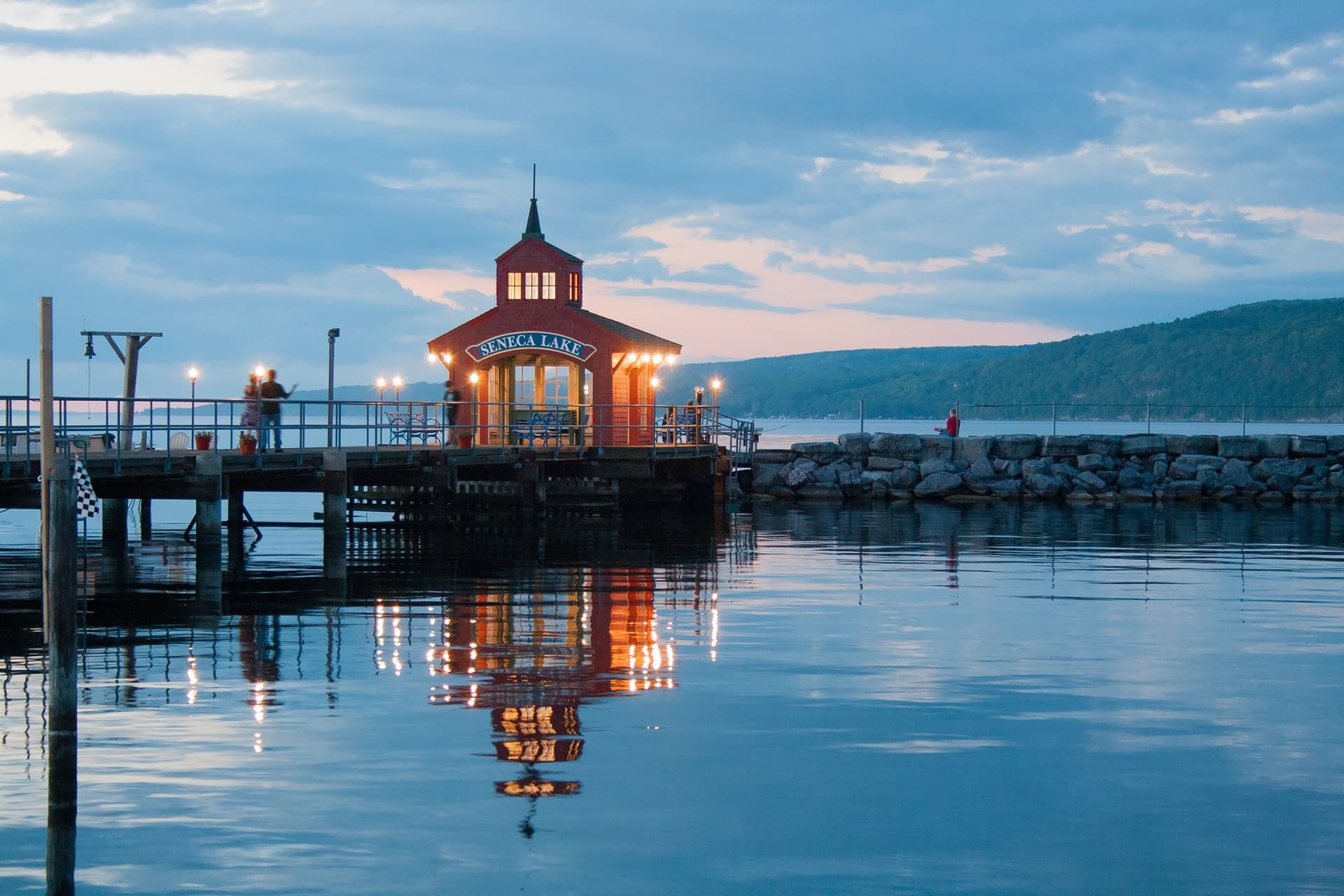
At 61 km long and 4.8 km wide, Seneca is the largest and deepest of the Finger Lakes. Its shores host more than thirty wineries, making it the oenological epicenter of the region. Watkins Glen, at its southern end, is known for its state park and racing circuit.
Cayuga
The longest of the lakes (63 km long and 3.8 km wide) is home to Ithaca, a university town and seat of Cornell University. Ithaca is also known as one of the towns claiming to have invented the sundae in the late nineteenth century.
Keuka
Its Y-shaped form is unique among the Finger Lakes. The village of Hammondsport, on its southern shore, serves as a gateway to several wineries specializing in riesling.
Canandaigua
Located in the western part of the network, Canandaigua features a developed waterfront and direct air access via its small regional airport.
Skaneateles
Renowned for the clarity of its waters, Skaneateles borders a village of the same name appreciated for its historic homes and lakeside shops.
What to see and do
Waterfalls and gorges
Nearly fifty waterfalls are recorded in the region. The Taughannock falls, near Cayuga Lake, reach 121 meters, or roughly three times the height of Niagara Falls. Watkins Glen State Park, at the southern end of Seneca Lake, lines 19 waterfalls along a gorge trail. Robert H. Treman State Park features Lucifer Falls, accessible via a trail of about 1.77 km, and Lower Falls that plunge into a rocky basin.
Wine routes
The climate tempered by the lakes and morainal soils suit crisp wine varieties. Riesling is the regional signature; there is also chardonnay in whites, cabernet franc and pinot noir in reds. Several marked wine routes circle Seneca, Cayuga and Keuka lakes. Ciders, craft beers and liqueurs round out the offering.
Museums and heritage
The Corning Museum of Glass traces 3,500 years of glass history, with glassblowing demonstrations. In Rochester, the George Eastman Museum is devoted to photography and film, housed in the founder of Kodak's residence. The Women's Rights National Historical Park at Seneca Falls documents the origins of the American feminist movement. In Syracuse, the New York State Fair takes place each late summer.
Outdoor activities
Deep-water fishing (rainbow trout, brown trout, pike), kayaking, sailing, hiking in state parks, cycling on secondary roads: activities are organized around the lakes. In winter, the region shifts to cross-country skiing and snowmobiling.
When to visit
May to September: the most versatile period, with mild temperatures for hiking and water activities. Higher occupancy and accommodation rates in July-August.
September-October: fall colors on vineyards and forests, harvest season, moderate crowds. Often considered the best time to visit.
Winter: snowy landscapes, some wineries remain open, but many outdoor attractions close or have limited access.
Practical information
Plan for a minimum of 3 to 4 days to tour two or three lakes without rushing, or a week for more thorough exploration including museums and wineries. A car is essential: there is no structured public transportation between the lakes. Diverse accommodations (lakeside inns, vineyard B&Bs, state park campgrounds, city hotels).
How to get there
From New York City, allow approximately four hours' drive northwest. Four airports serve the region:
- Frederick Douglass Greater Rochester International Airport (ROC), convenient for the western lakes;
- Syracuse Hancock International Airport (SYR), well-positioned for the eastern lakes;
- Buffalo Niagara International Airport (BUF), about 1.5 to 2 hours from the western lakes;
- Canandaigua, a small regional airport for general aviation flights.
The scenic route between Rochester and Syracuse crosses several of the lakes and provides a good overview of the region.
In the surrounding area
Niagara Falls are approximately 2 hours' drive to the west. Rochester and Syracuse, the main cities in New York State after NYC and Buffalo, complement the stop. To extend a larger journey across the États-Unis, destinations such as Broadway in Nashville or the Country Music Hall of Fame offer interesting cultural contrast.
Frequently asked questions
Frequently asked questions
Three to four days are sufficient to discover two or three lakes, their vineyards and a state park. A week allows you to cover the entire region with museums and multiple waterfalls.
Seneca Lake concentrates the largest number of wineries (more than thirty) and is often the starting point for wine routes. Cayuga and Keuka are also well-equipped with wineries.
Yes. Public transportation does not connect the lakes to each other. Car rental from Rochester, Syracuse or New York is the most practical solution.
Yes. The falls are about 2 hours' drive from Canandaigua, the westernmost of the Finger Lakes. A combined itinerary from Buffalo or Rochester is easy to organize.
From late September to mid-October, depending on the year. Vineyards and mixed forests take on spectacular hues, and crowds are more moderate than in peak summer.
Planning your trip
Finger Lakes fit well into a broader itinerary in the eastern États-Unis. To build your program and get personalized advice, consult our suggestions for trips to the États-Unis.
Interested in this visit?
We can include it in your personalised itinerary.