Catoosa
Catoosa
A Route 66 stop 20 km from Tulsa, Catoosa brings together the famous Blue Whale, Tulsa's inland port and Cherokee heritage.
A small port town in northeastern Oklahoma, Catoosa is home to roughly 6,950 residents and sits about twenty kilometers east of Tulsa. The town owes its reputation to a concrete blue whale positioned along Route 66, its inland port opening onto the Arkansas River, and a Cherokee heritage whose name preserves the memory: Catoosa means "High in the Hills."
Why visit Catoosa
Catoosa is not a destination in itself, but a stop that makes sense for three specific reasons. First, the Blue Whale, one of the most photographed stops on Route 66 in Oklahoma. Next, Tulsa Port, the inland terminus of the waterway system connecting the Mississippi to the Gulf of Mexico—a rarity in the United States. Finally, its immediate proximity to Tulsa allows you to include the city in a broader itinerary without major detours.
Travelers drawn to Native American culture will also find the annual Cherokee art market and the International Cherokee Film Festival, two events that break the city's usual rhythm.
History
The Catoosa territory was occupied by the Cherokee in the 19th century, following their forced displacement from the southeastern United States. The city came under American administration in 1883. It then lived off agriculture, with livestock ranches, a flour mill and a coal quarry.
The industrial turning point came in the 20th century with the development of the Arkansas River as a navigable waterway. The Tulsa Port of Catoosa was inaugurated in 1971; in that first year alone, cargo volume reached 86,000 tons. The port became one of the busiest inland ports in the United States and reshaped the local economy.
In April 1993, a violent tornado swept through Catoosa and claimed seven lives: six at a gas station and one in a mobile home. The episode reminds us that the region lies in tornado alley.
What to see in Catoosa
The Blue Whale of Route 66
This is the town's signature attraction. Built in 1972 by zoologist Hugh S. Davis to provide a watering hole for his grandchildren, this concrete whale measures over 24 meters long and rises to 6 meters in height. It stands on the east side of downtown, along Route 66. Swimming, once permitted, is no longer allowed since the site's takeover by Davis's daughter. Visits remain free and a photo stop is a must for anyone traveling the Mother Road.
Catoosa Historical Society Museum
Housed in a former railway station, this small local museum brings together photographs of Cherokee tribes, a logbook dated 1897, and a period mailbox, a reminder of the era when mail was delivered by carriage. Plan for less than an hour of visiting.
D W Correll Museum
An eclectic collection assembled by a local resident: primarily vintage American cars, but also silverware, shells and gemstones. A brief stop that will especially appeal to classic car enthusiasts.
Oklahoma Maritime Education Center
Nestled against the port, this center traces the construction of the waterway and the operation of Tulsa Port of Catoosa using maps, touch screens and video projections. Self-guided or guided tours available depending on the day.
Redbud Valley Nature Preserve
Away from the city, this natural site alternates between plains, forests and wildflower meadows. Several marked hiking trails allow for a half-day in nature. Note: the preserve only opens on weekends; check access days before planning the detour.
Hard Rock Hotel & Casino Tulsa
Located on Catoosa territory, this vast complex managed by the Cherokee Nation groups slot machines, gaming tables, restaurants, performance venues and a hotel. It is one of the region's main nightlife hubs.
When to visit
Autumn (September to November) offers the most comfortable conditions: mild temperatures, low humidity, often clear skies. Spring is pleasant but coincides with tornado season, which is frequent between April and early June; monitor weather bulletins if you travel during this period.
Summers are hot, with peaks around 34°C and high humidity. Winters can be harsh, with marked cold snaps but little lasting snow.
Practical information
- Recommended visit duration: a half-day is enough for the Blue Whale and a museum; plan a full day if you add Redbud Valley or an evening at the casino.
- Accommodation: limited options on-site; most travelers stay in Tulsa.
- Dining: chain restaurants along major roads, plus a wider range within the Hard Rock.
- Safety: in case of tornado alert, follow local instructions and head to shelter.
How to get there
Catoosa is primarily reached by car. From Tulsa, expect about twenty kilometers via Interstate 44 or historic Route 66, roughly 25 minutes of driving. From Oklahoma City, plan for approximately 1 hour 45 minutes to 2 hours by I-44 (just under 200 km).
The nearest airport is Tulsa International Airport, about twenty minutes' drive away. A rental car remains the most practical solution: there is no public transit directly linking Catoosa, and the town is best navigated by car.
Nearby
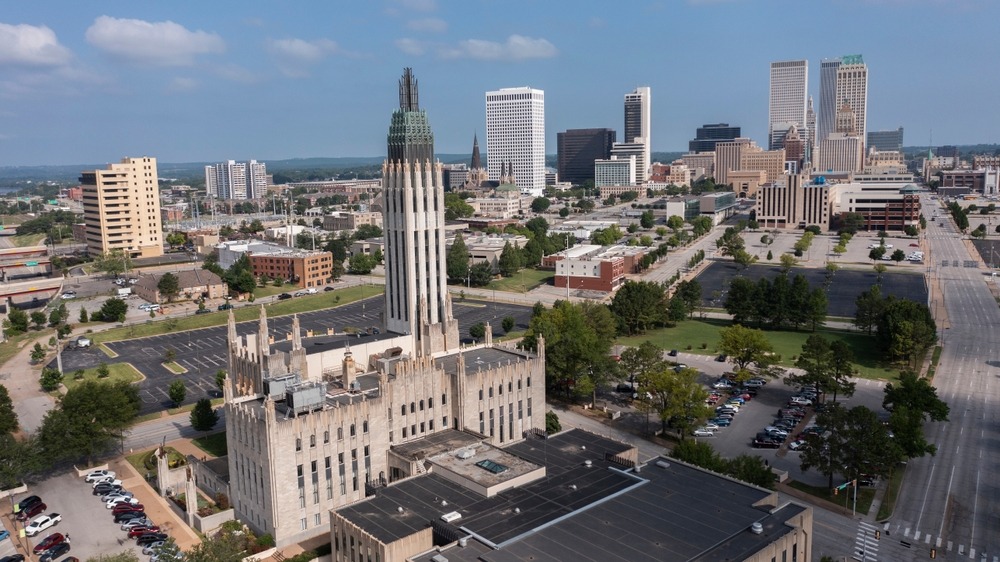
Tulsa, 20 km away, concentrates the region's main points of interest: Philbrook and Gilcrease museums, Art Deco district, music scene, restaurants. It is the logical base for exploring. Further southwest, Route 66 crosses Oklahoma for nearly 650 kilometers and allows you to chain together other iconic stops like Cadillac Ranch in neighboring Texas.
To extend the American wide-open-spaces experience, Antelope Canyon in Arizona or Austin museums, including the Bullock Museum, round out a broader itinerary.
Frequently asked questions
Frequently asked questions
A half-day is enough for the Blue Whale and a museum. Plan a full day if you add the Redbud Valley preserve or an evening at the Hard Rock.
No. Since the site's takeover by Hugh S. Davis's family, swimming is prohibited. Visits remain free and open for photos.
Autumn, from September to November, offers the most pleasant temperatures. Avoid late spring if possible, due to frequent tornadoes between April and early June.
Tulsa offers a much wider range of accommodations and is only 20 km away. Most travelers choose Tulsa as a base and visit Catoosa on a day trip.
The detour is mainly justified if you're following Route 66 or if Tulsa is already in your itinerary. For a shorter trip, it's better to concentrate your time on Tulsa itself.
Plan your trip
Catoosa fits naturally into a Route 66 road trip or an itinerary centered on Oklahoma and the American South. To build a custom trip, explore our United States travel ideas.
Interested in this visit?
We can include it in your personalised itinerary.